
Google Maps Statistics 2026: Users, Local Search, Business Impact & Trends



Google Maps has 2 billion+ active monthly users in 2026, putting it in the top tier of Google’s consumer products. This guide compiles verified Google Maps statistics across users, coverage, engagement, business impact, anti-spam enforcement, monetization, and key product milestones.
It’s built for marketers, local SEO teams, multi-location operators, and developers who need current benchmarks for visibility, discovery, and Maps-driven actions.
We keep things up to date with fresh data every quarter. This is the Q1 2026 edition.
Google Maps Statistics (2026 Highlights)
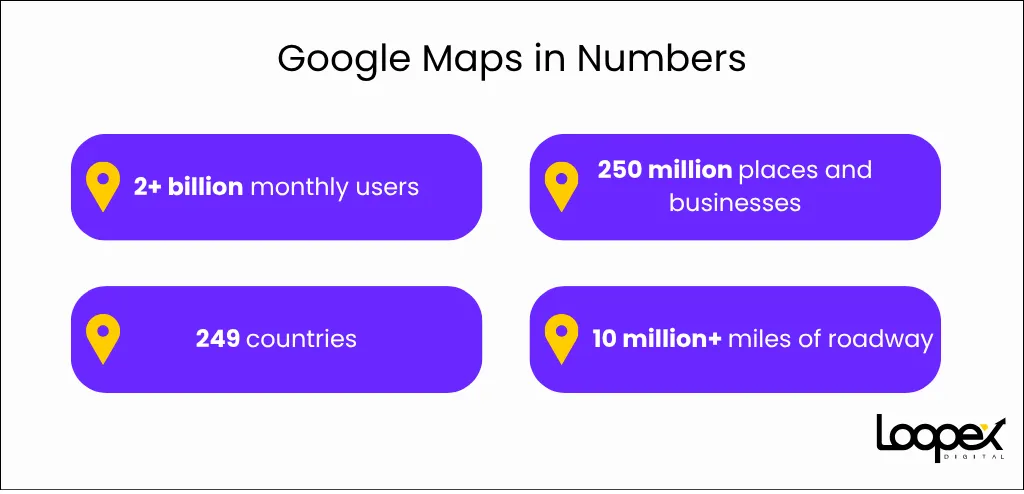
- Google Maps surpassed 2 billion monthly users in 2024, and as of 2026, the active monthly user count stays above 2 billion.
- Google Maps has mapped 249 countries and territories as of 2026.
- Google Maps lists information for about 250 million places and businesses globally.
- Street View covers 10 million+ miles of roadway and 36 million square miles of satellite imagery.
Google Maps General Statistics
Before we discuss the Google Maps statistics, let’s identify what a Google Maps “user” (app vs. web) is to avoid confusion.
A Google Maps “user” can include people using the mobile app and people using Maps on the web. The 2 billion monthly user milestone explicitly includes both app and web usage.
- “Monthly users” refers to unique people active in a given month.
- “Monthly visits” count sessions and can include multiple visits from the same person, which is why visits can rise even when unique users stay flat.
Now let’s see the stats themselves.
Google Maps Popularity (Users, Downloads, Reach)
- Google Maps surpassed 2 billion monthly users in 2024, and as of 2026, the active monthly user count stays above 2 billion (Source).
- According to our latest review, Google Maps has 10 billion+ downloads on the Google Play Store.
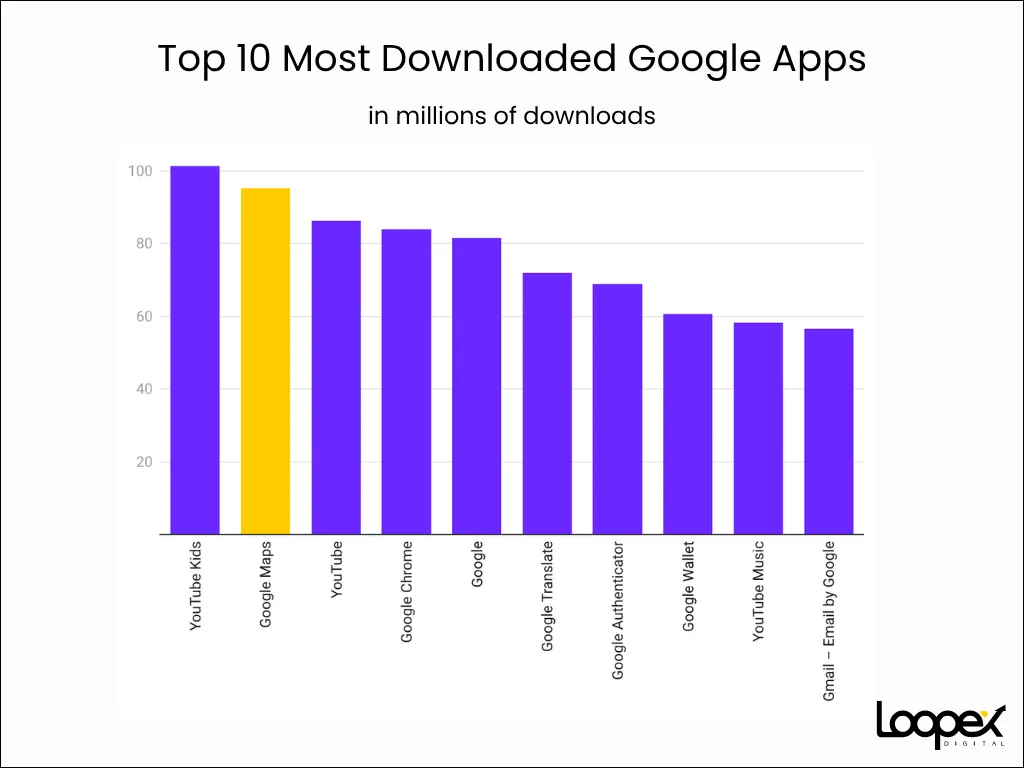
- Google Maps ranked 2nd among the most downloaded Google applications globally as of late 2025 (Source).
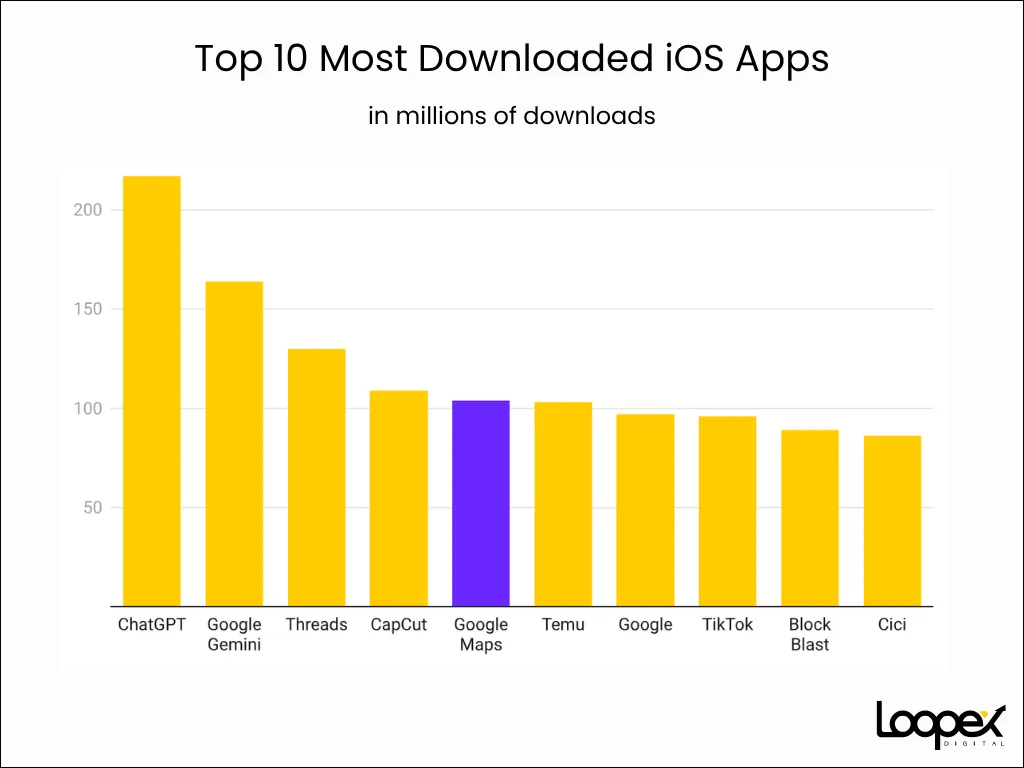
- Google Maps was the 5th most downloaded IOS app in 2025, with 104 million downloads (Source).
Google Maps Audience Statistics
Google Maps reaches people through navigation, search, and “near me” discovery. The audience also includes businesses and creators who add photos, reviews, and edits that influence what customers see.
Google Maps Demographics Statistics
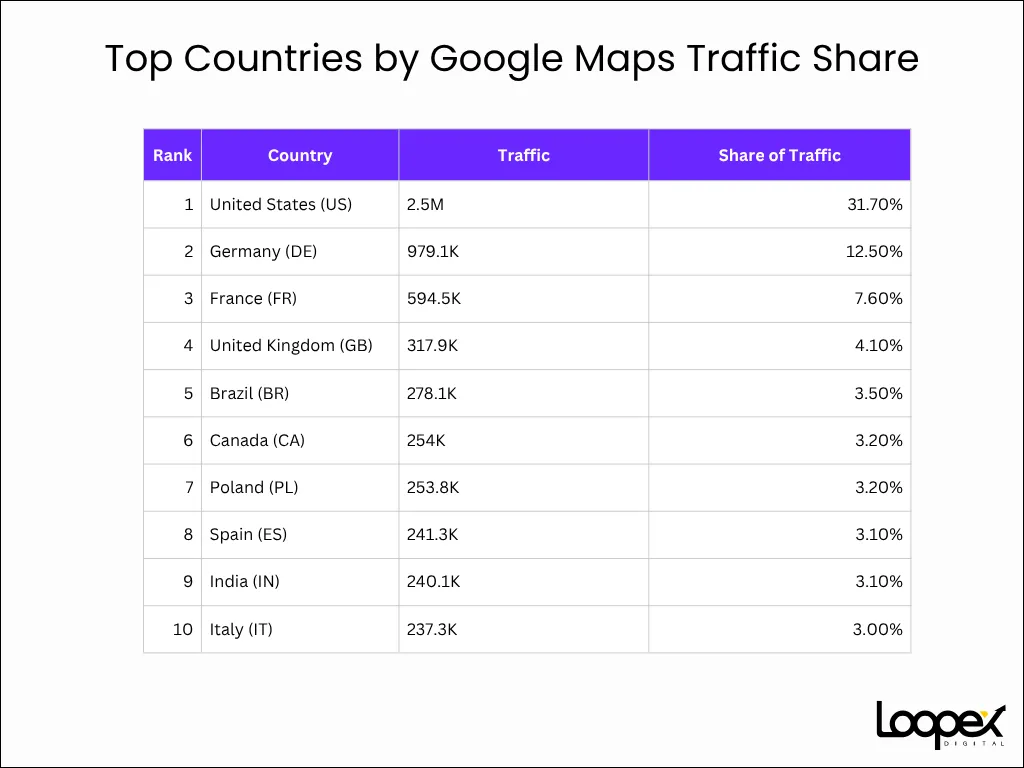
- According to our study, the United States, Germany, and France generate the highest levels of web traffic to Google Maps, making them the platform’s top three traffic-driving countries.
- 26.45% of Google Maps users are aged 25 to 34 (the biggest age group).
- 54.08% of Google Maps users are male, while 45.92% are female.
What Do People Search for on Google Maps?
Detailed data on specific search queries is limited, but available research indicates that Google Maps usage is concentrated in the following categories (Source):
- Science & Education: 2.81%
- Travel & Tourism: 2.42%
- Food & Drink: 2.37%
- Computers, Electronics & Technology: 2.21%
- Others: 90.19%
The top 3 most-viewed places on Google Street View are the Burj Khalifa in Dubai, the Eiffel Tower in Paris, and the Taj Mahal in Agra (Source).
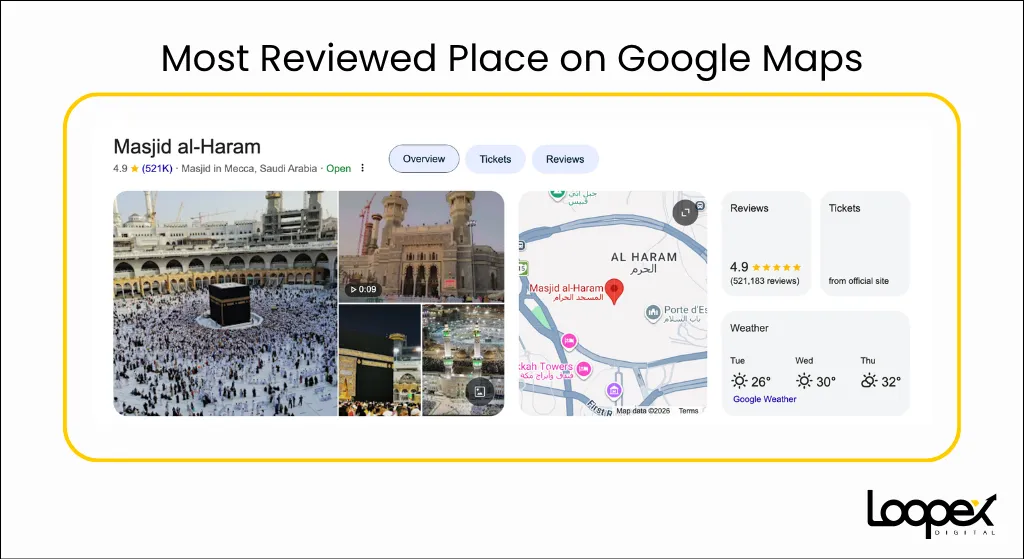
As of 2026, Masjid al-Haram (the Great Mosque of Mecca) holds the record for the most reviews on Google Maps, with 521,183.
Google Maps Users and Engagement Statistics
Engagement on Google Maps often shows up as short, repeated sessions. Contributions also matter because photos, reviews, and edits shape what future searchers see in the map results (Source 1, Source 2):
- 120 million+ Local Guides contribute to Google Maps across 24,000 cities and towns.
- People submit 20 million+ contributions to Google Maps every day, including reviews, ratings, photos, and edits.
- Users average about 50 Google Maps sessions per month, each lasting roughly 3 minutes.
Google Maps Navigational, Coverage, and Routing Statistics
Navigation performance depends on coverage, routing accuracy, and mode options like transit, cycling, and indoor guidance. Google also positions Maps as a sustainability tool through eco-routing features
- Google Maps covers 98-99% of the world's population, including 36 million square miles of high-definition satellite imagery (Source).
- Google Maps Street View imagery covers 10 million+ miles of roads.
- Google Maps’ ETA predictions are about 97% accurate, due to the integration of DeepMind AI.
- Google’s eco-friendly routing helped prevent an estimated 1.2 million metric tons of carbon emissions since its launch. As of 2026, eco-friendly routing is available in the U.S., Canada, and many European countries.
Google Maps Business Statistics
For everyday users, Google Maps is for finding places and directions. But businesses use it both to appear in local listings and the Map Pack through local SEO, and to integrate Google’s mapping data into their own websites and apps through an API (a tool that lets their systems pull in maps, location data, routing, and traffic automatically).
- Google Maps surfaces information for about 250 million places and businesses worldwide (Source).
- More than 5 million active apps and websites use core Google Maps Platform products.
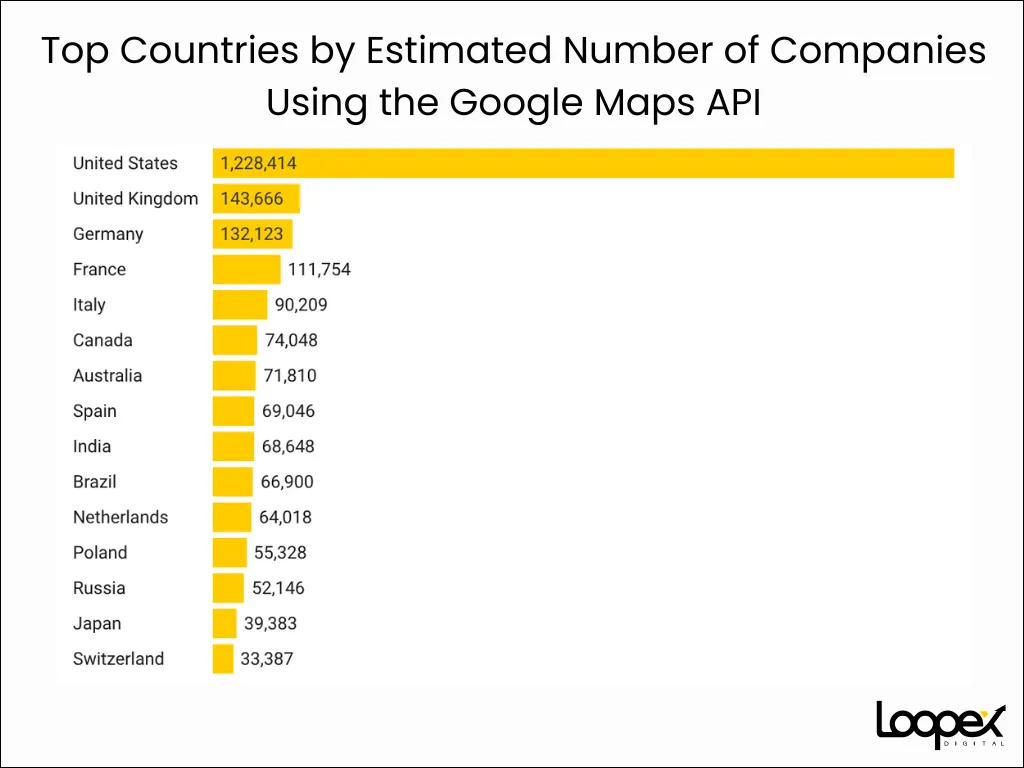
- More than 1.2 million companies worldwide use the Google Maps API, with the United States leading by country and manufacturing ranking as the top industry (Source).
The top countries using the Google Maps API are as follows (Source):
- United States
- United Kingdom
- Germany
- France
- Italy
- Canada
- Australia
- Spain
- India
- Brazil
- Netherlands
- Poland
Major Google Maps Milestones (2005-2026)
Google Maps Timeline feature tracks users’ location history, helping them revisit past trips and daily commutes. It provides insights into travel habits, visited places, and personalized recommendations.
| Year | Milestone | Strategic Impact |
|---|---|---|
| 2005 | Google Maps launches (draggable maps, satellite view) + Maps API | Foundation for global navigation + developer ecosystem |
| 2007 | Street View launches | Transforms Maps into a visual exploration platform |
| 2009 | Free turn-by-turn GPS navigation expands | Accelerates mobile adoption; challenges standalone GPS devices |
| 2011 | Indoor maps introduced | Expands coverage into commercial infrastructure |
| 2015 | Offline maps expand; Local Guides scale | Strengthens reliability + user-generated data ecosystem |
| 2017 | Parking difficulty + smarter recommendations | Moves toward predictive, contextual navigation |
| 2019 | Incognito Mode launches | Adds privacy controls for location tracking |
| 2020 | COVID-era crowdedness + transit alerts | Positions Maps as a real-time public data infrastructure |
| 2021 | Eco-friendly routing + Live View (AR) | Introduces sustainability + augmented navigation |
| 2022 | Immersive View rollout begins | Advances toward AI-powered spatial visualization |
| 2023 | AI-enhanced recommendations + improved indoor accuracy | Deepens personalization and discovery |
| 2024 | Lens in Maps + expanded immersive discovery | Blends AR, AI, and community-driven updates |
| 2025 | Conversational AI search inside Maps | Enables complex, natural-language local discovery |
| 2026 | Predictive routing + expanded business intelligence layer | Strengthens Maps as a logistics and infrastructure engine |

Google Maps Recent Trends and Developments (2026)
Maps is moving from command-based navigation to conversational co-pilot mode in 2026.
Recent updates show Google layering Gemini AI directly into navigation, turning static directions into interactive trip assistance. Users can ask follow-up questions mid-route, get contextual recommendations, and receive landmark-based directions instead of distance-only prompts (Source).
A few key shifts are supporting this transition (Source):
- Conversational navigation: Gemini-powered features allow users to ask about traffic, nearby stops, or specific buildings while navigating, making Maps interactive rather than instruction-only.
- Landmark-based directions: Instead of “Turn in 300 meters,” users may hear directions tied to real-world reference points, increasing clarity in dense urban areas.
- Hands-free in-app chat: Maps can surface reviews, route context, and live data without requiring screen-heavy interaction.
- AI-powered discovery: Lens in Maps and visual search let users point their camera at a place and receive contextual information instantly.
- Developer AI grounding: “Grounding with Google Maps” in the Gemini API enables AI applications to anchor generative responses in real-world geospatial data.
Google Maps vs Competitors (Apple Maps, Waze, Others)
Competitive differences usually show up in coverage, features, and engagement patterns. For example, Google Maps offers features like offline maps that competitors do not.
- In one navigation-app survey, 67% of respondents preferred Google Maps, with Waze at 12% and Apple Maps at 11% (Source).
- Users average about 50 Google Maps sessions per month, each lasting roughly 3 minutes, while Apple Maps users average about 12 minutes per month (Source: LocalZen).
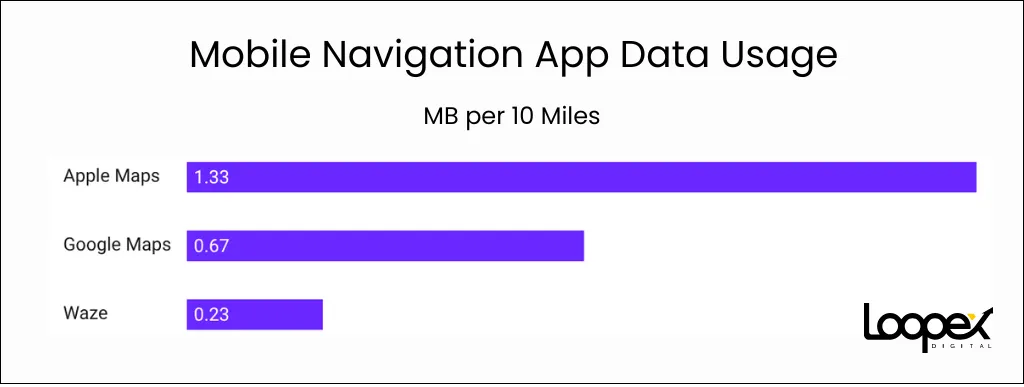
- Compared with Google Maps (0.67 MB per 10 miles), Apple Maps used the most data (1.33 MB per 10 miles), while Waze used only about 0.23 MB per 10 miles (Source).
Google Maps Revenue and Monetization Statistics
Google Maps monetization flows through ads and paid platform services. Google also monetizes Maps by licensing Maps Platform and selling detailed rooftop imagery and data for approximately 480 million buildings across 40 countries (Source).
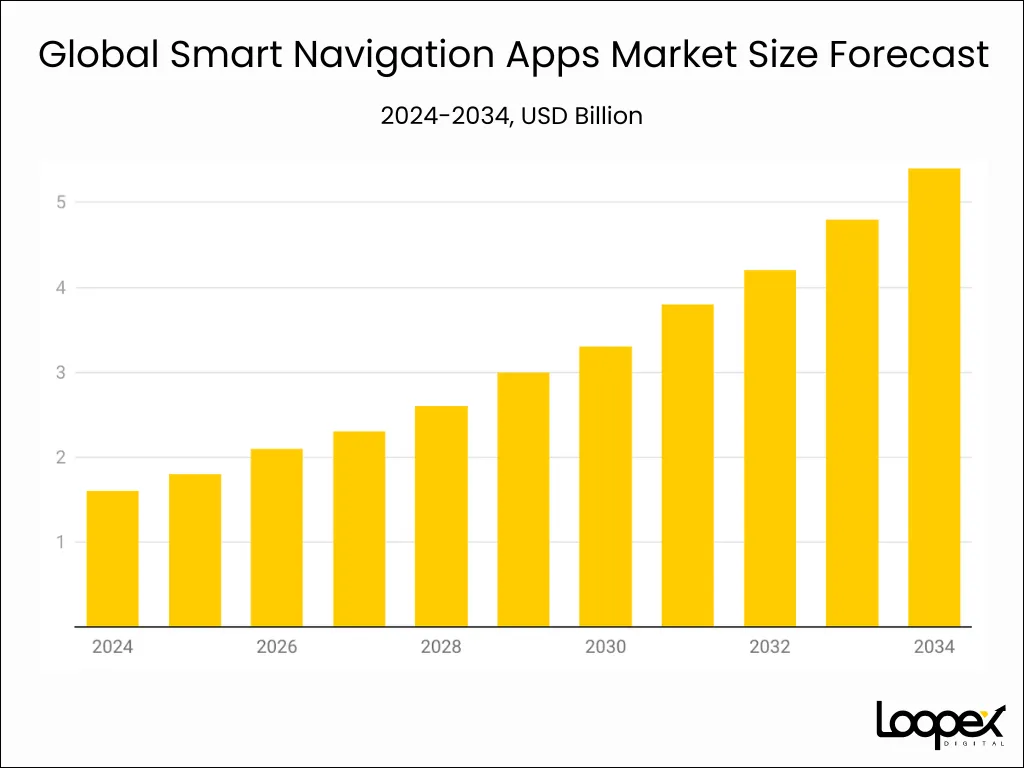
Alphabet Inc. does not report Maps revenue as a standalone line item. Still, the overall smart navigation app market is projected to grow to about $5.4 B by 2034 at a 12.8% CAGR.
Key Takeaways from Google Maps Statistics
If you’re a marketer, multi-location operator, or developer, these are the takeaways from our Google Maps statistics that matter:
- Maps is a demand capture channel. With 2B+ monthly users and 46% of Google searches carrying local intent, Google Maps influences decisions at the exact moment users look for nearby products or services.
- Visibility is dynamic, not static. With 120M+ Local Guides, 20M+ daily contributions, and users averaging 50 sessions per month, listings constantly shift in response to reviews, edits, and engagement signals.
- Scale creates competitive insulation. Coverage across 249 countries, 250M places, and 98–99% of the world’s population (combined with 97% ETA accuracy) makes Google Maps a core infrastructure layer, not just a navigation app.
Integrate the right changes into your workflow based on these insights, and if you need support to improve your local visibility and performance on Google Maps, contact us.
FAQs
How many people use Google Maps?
Google Maps' number of users surpassed 2 billion in 2026. It’s been stable after 2024.
Who uses Google Maps?
Google Maps serves over 2 billion monthly active users, with young adults aged 18–34 representing nearly half of all traffic. The platform's user base is primarily composed of daily commuters, travelers, and pedestrians.
What’s the most searched address on Google Maps on Jan 9th 2026?
The most searched landmark on Jan 9th, 2026, was the Burj Khalifa in the UAE. The address for it is 1 Sheikh Mohammed bin Rashid Blvd, Downtown Dubai, United Arab Emirates.
In general, high-traffic tourist destinations and global landmarks get the highest searches in Google Maps.
How many people use GPS every day?
Over 4 billion people around the world use GPS (Global Positioning System).
What’s Google Maps’ data usage per hour for navigation?
Google Maps uses 0.67 MB per 10 miles traveled, which is 4.02 MB per hour (for a speed of 60 mph). Note that using Satellite View can increase usage to roughly 1.33 MB per 10 miles!
What’s Google Maps' market share?
As of early 2026, Google Maps dominates the digital mapping and navigation market with an estimated 67% to 80% global market share.
What’s Google Maps' net worth?
Google Maps’ net worth in 2025 or previous years hasn’t been disclosed. That’s because it isn’t a standalone company. It’s a product owned by Alphabet Inc. (Google), so its value isn’t reported separately.
References
- 9to5Google. Google Maps Surpasses 2 Billion Monthly Users. Accessed on February 20, 2026.
https://9to5google.com/2024/10/29/google-maps-2-billion - Apple World Today. Google Maps Has 67% of the Navigation App Market Compared to Apple Maps’ 11%. Accessed on February 20, 2026. https://appleworld.today/2018/07/google-maps-has-67-of-the-navigation-app-market-compared-to-apple-maps-11/
- Business of Apps. Most Popular Apps Data. Accessed on February 20, 2026.
https://www.businessofapps.com/data/most-popular-apps/ - BuiltWith Trends. Google Maps API Usage Statistics. Accessed on February 20, 2026.
https://trends.builtwith.com/mapping/Google-Maps-API - CNBC. Google Maps Turns 20, Adds AI Features, New Countries to Beat Apple. Accessed on February 20, 2026.
https://www.cnbc.com/2025/01/18/google-maps-turns-20-adds-ai-features-new-countries-to-beat-apple.html - Data Landbase. Google Maps API Free Usage Data. Accessed on February 20, 2026.
https://data.landbase.com/technology/google-maps-api-free/ - Developers Google. Google Maps Coverage Details. Accessed on February 20, 2026.
https://developers.google.com/maps/coverage - Eastleigh Voice. Top 10 Most Downloaded Google Apps in 2025. Accessed on February 20, 2026.
https://eastleighvoice.co.ke/infographics/215167/top-10-most-downloaded-google-apps-in-2025 - Electro IQ. Google Maps Statistics. Accessed on February 20, 2026.
https://electroiq.com/stats/google-maps-statistics/ - Finance Yahoo. Google Maps Gets Smarter and More Conversational. Accessed on February 20, 2026.
https://finance.yahoo.com/news/google-maps-gets-smarter-more-193300607.html - Google. Gemini Navigation Features and Landmark Lens in Maps. Accessed on February 20, 2026.
https://blog.google/products-and-platforms/products/maps/gemini-navigation-features-landmark-lens/ - Google. Google Maps 101: How Contributed Content Makes Maps Helpful. Accessed on February 20, 2026.
https://blog.google/products-and-platforms/products/maps/google-maps-101-how-contributed-content-makes-maps-helpful/ - Google. Google Maps Generative AI for Local Guides. Accessed on February 20, 2026.
https://blog.google/products-and-platforms/products/maps/google-maps-generative-ai-local-guides/ - Google. Google Maps More Detailed and Colorful Map Update. Accessed on February 20, 2026.
https://blog.google/products-and-platforms/products/maps/more-detailed-colorful-map/ - Google Maps Blog. Remembering the Titanic. Accessed on February 20, 2026.
https://maps.googleblog.com/2012/04/remembering-titanic.html - Google Maps Platform. 9 Things to Know About Google’s Maps Data Beyond the Map. Accessed on February 20, 2026.
https://mapsplatform.google.com/resources/blog/9-things-know-about-googles-maps-data-beyond-map - Hexus. Google Maps Street View Covers 10 Million Miles of Roadway. Accessed on February 20, 2026.
https://hexus.net/business/news/internet/137891-google-maps-street-view-covers-10-million-miles-roadway - LocalZen. Google Maps Statistics and Interesting Facts. Accessed on February 20, 2026.
https://localzen.com/blog/google-maps-statistics-and-interesting-facts - Market.us. Smart Navigation Apps Market Report. Accessed on February 20, 2026.
https://market.us/report/smart-navigation-apps-market/ - On The Map. Google Maps Statistics. Accessed on February 20, 2026.
https://www.onthemap.com/blog/google-maps-statistics/ - Statista. People Who Use Their Cell Phone for Maps or GPS Navigation in the U.S. Accessed on February 20, 2026.
https://www.statista.com/statistics/231615/people-who-use-their-cell-phone-for-maps-gps-navigation-usa/ - SQ Magazine. Google Maps Statistics. Accessed on February 20, 2026.
https://sqmagazine.co.uk/google-maps-statistics/ - Technology Magazine. Google Maps Partners with DeepMind AI for Improved ETAs. Accessed on February 20, 2026.
https://technologymagazine.com/ai-and-machine-learning/google-maps-partners-deepmind-ai-improved-etas - The Zebra. Waze vs Apple Maps vs Google Maps Comparison. Accessed on February 20, 2026.
https://www.thezebra.com/resources/driving/waze-vs-apple-maps-vs-google-maps/ - Travel + Leisure Asia. Most Visited Tourist Places on Google Street View. Accessed on February 20, 2026.
https://www.travelandleisureasia.com/in/destinations/most-visited-tourist-places-on-google-street-view/ - Wikipedia. Google Maps. Accessed on February 20, 2026.
https://en.wikipedia.org/wiki/Google_Maps
Maria Harutyunyan is the Co-founder and Head of SEO at Loopex Digital. She specializes in general SEO and strategy for SaaS, e-commerce, and B2B brands. An expert in on-page (onsite) SEO with more than 10 years in search, she is recognized by the SEO community as one of the top voices in the field. She has been featured in Forbes, quoted as an SEO expert on Shopify, and writes for Convince & Convert, SE Ranking, and Mangools (KWFinder). She is also the founder of Armenia's first SEO Academy, having trained 500+ marketers.
Submit the form - Get Free Proposal
%202.png)
24 hours





Submit the form - Get Free Proposal
24 hours

