
SEO for Optometrists Strategies and Keywords by Optometry SEO Agency
Increase your patient base with 2026 optometrist SEO, delivered by a top optometry SEO agency: effective keywords, structure, and local rankings.
5.0




Big-box optical chains and corporate-owned clinics move fast with bigger marketing budgets, making it challenging for independent optometrists to keep up. With more than 45,000 optometrists competing for the same patients, ranking well takes more than a simple website.
You’re also spending time correcting what online app prescriptions miss while covering the cost of equipment upgrades, such as OCT, topographers, and retinal imaging systems. It puts pressure on both growth and patient education.
SEO for optometrists helps you break that cycle. Strong rankings bring a steady flow of patients without chasing ads, which enables you to invest in new technology and stay visible in your community.
In this guide, you’ll see the same SEO approach our optometry SEO professionals have used to help 40+ optometrists in the U.S. attract more qualified patients.
Why Do Optometrists Need to Invest in SEO?
- Optometrist SEO helps smaller clinics push past the ad dominance of big-box optical chains, giving independent doctors steady visibility without matching corporate budgets.
- SEO lets you rank for insurance-heavy searches like “optometrist that accepts vsp,” “eye exam with medicaid,” or “blue cross vision doctor,” which tend to convert quickly because patients are ready to schedule.
- Optometry SEO captures month-by-month search trends for issues your clinic already treats: spring allergy eyes, winter dry eye, irritation from indoor dry heat, or summer contact lens discomfort.
- SEO highlights medical services many patients don’t realize are available outside ophthalmology, including dry eye therapy, myopia management, Ortho-K, specialty scleral lenses, diabetic eye exams, and retinal imaging.
- If you look at what SEO really costs, you’ll see that it’s more cost-effective than any other marketing channel. You avoid overreliance on PPC, where corporate bidders drive up click prices for terms like “eye exam near me,” making ads costly for small clinics.
- SEO supports long-term revenue, helping you keep up with rising diagnostic equipment costs: OCT units, topographers, widefield retinal imaging, and updated autorefractors.
Now, let’s move on to the first step of optometry SEO: choosing the right keywords.
Do Keyword Research and Competitive Analysis for Your Optometric Website
The starting point for any optometric SEO plan is a clear list of the services you offer. Write out each one, such as:
- dry eye treatment
- eye exams
- myopia control
- diabetic eye exams
- family eye care
Drop these terms into tools like Ahrefs, SEMrush, or Google Keyword Planner to see what patients search for most often and how much competition each term has.
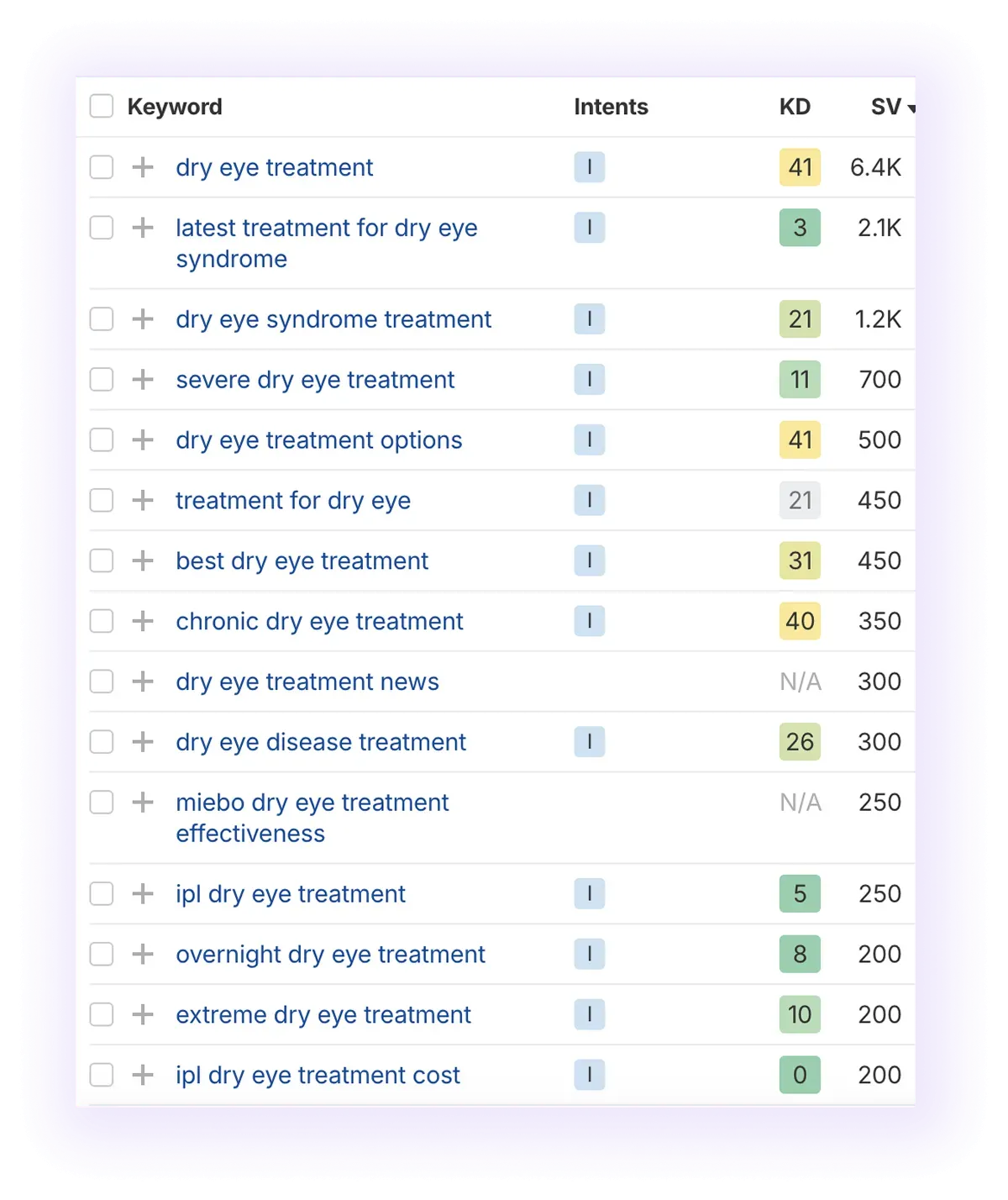
Keep your broad keywords like “optometric clinic,” “optometrist,” and “eye doctor,” but also target high-intent, high-volume, low-difficulty phrases as they also have strong CTR potential. These terms usually attract patients who are close to booking.
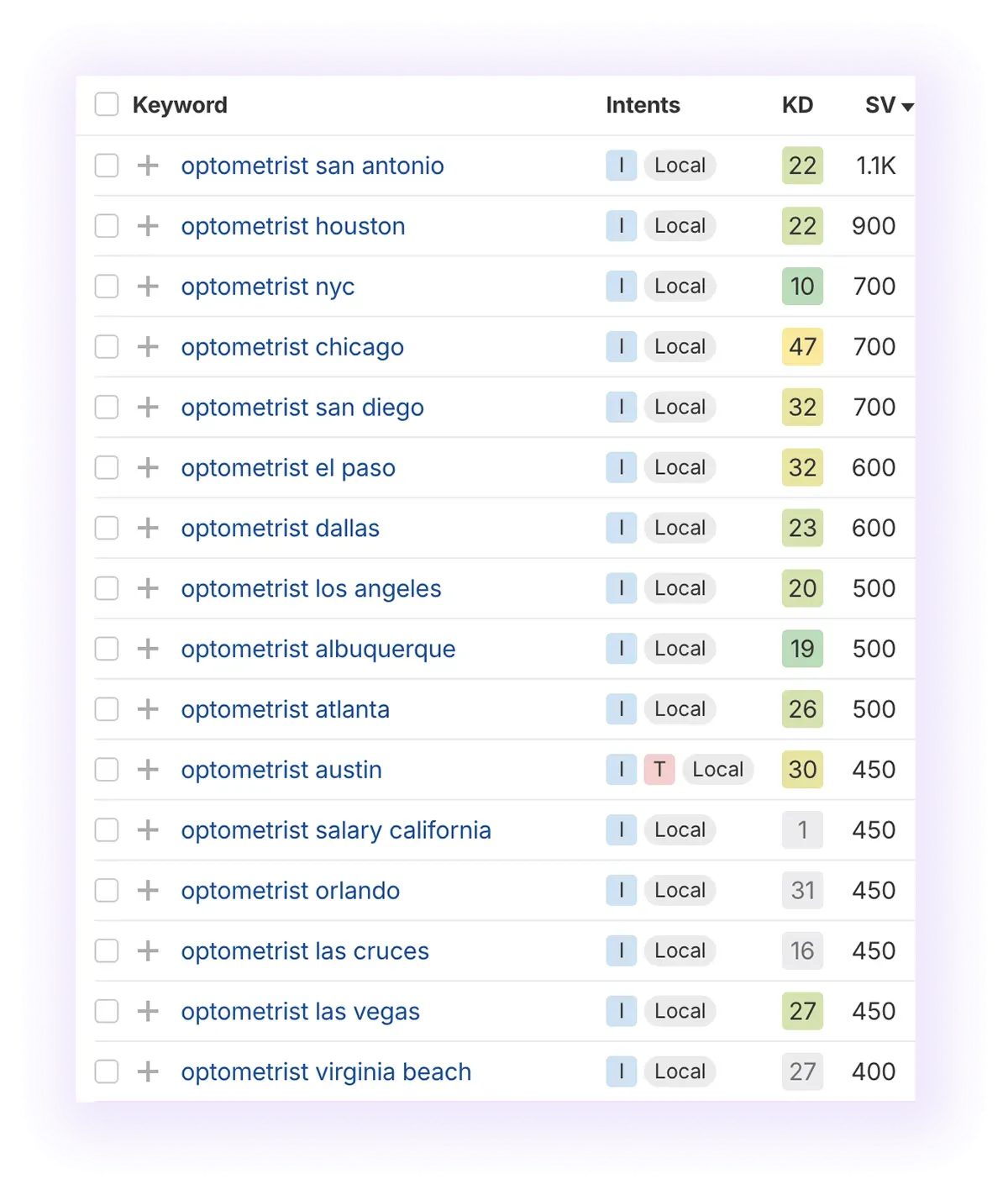
Use the location filters in your keyword tools to see which nearby neighborhoods and cities show the strongest demand. This helps you focus on areas that bring in the most qualified patients.
We also recommend using our complete keyword research guide to assist you in your discovery process.
Top 30 Real Keywords for Optometrists
Transactional for Targeting Potential Patients
- contact lens exam
- emergency eye care
- eye care services
- eye care center
- optometric center
- diabetic eye exam
- family eye care services
- pediatric eye doctor
- pediatric eye exam
- lasik eye surgery
- cataracts surgery
- eye disease management
- cornea surgery
- myopia control
- glaucoma treatments
Informational for Educating Patients
- dry eye treatment options
- best glasses for astigmatism
- how often eye exams
- contact lens fitting process
- children myopia control methods
- diabetic eye exam guidelines
- difference between optometrist ophthalmologist
- what causes blurry vision
- eye allergy relief tips
- computer vision syndrome solutions
- blue light glasses effectiveness
- early signs of glaucoma
- retinal imaging exam explained
- choosing prescription sunglasses online
- how to prevent myopia
Now that you have the keywords patients use for symptom searches and booking-ready searches, the next step is making sure your clinic shows up for both.
If you want support turning that keyword list into real growth, our optometry SEO agency specializes in this area. Reach out anytime, and we’ll build a plan that fits your clinic.
Outline Your Optometric Website Hierarchy and Menu Structure
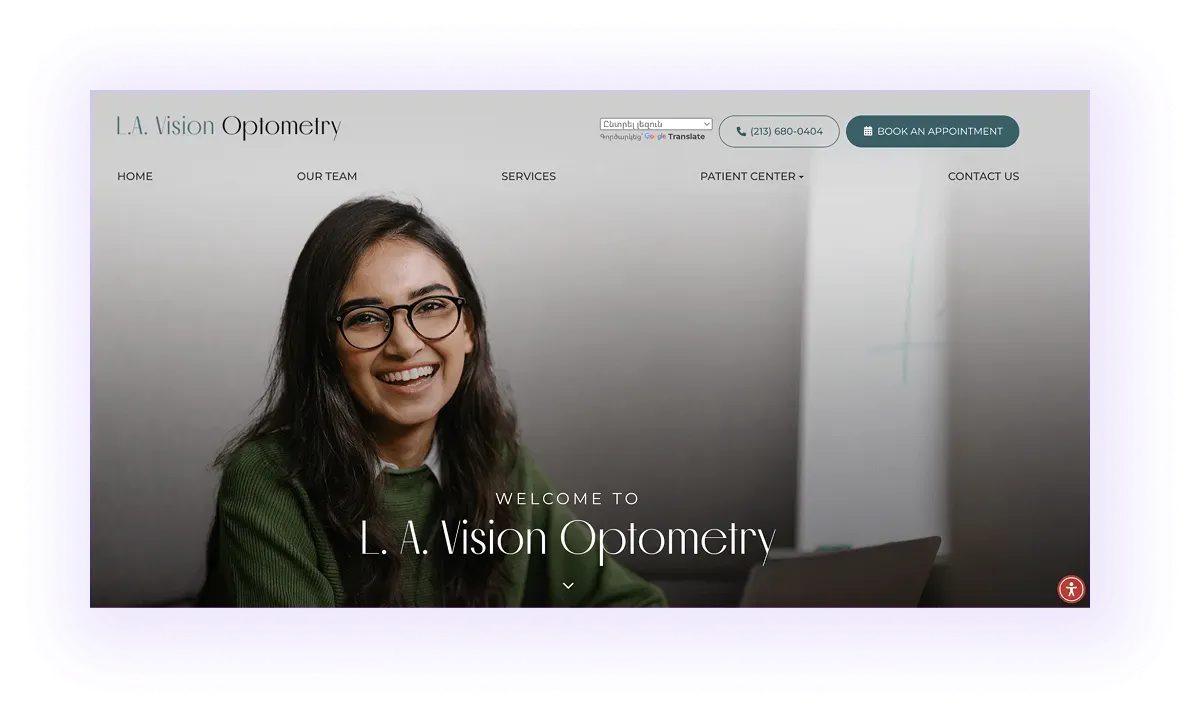
Map each keyword we found in the previous step to its appropriate category. Different optometric searches match different patient goals, so start by building three core static pages:
- Homepage: Target broad terms like “optometric clinic,” “optometrist,” and “eye doctor.” Give a quick overview of your services and highlight what your clinic does best.
- About Us (Our Team): Share your clinic’s story, training, certifications, and short bios with photos of your doctors and team. This builds trust before a patient ever calls.
- Contact Us: Include your contact form, click-to-call buttons, and links to messaging tools you use, such as WhatsApp. This page should make reaching your clinic as simple as possible.
Once these pages are complete, place them in your main navigation so Google and your visitors can move through the site without confusion.
Service Pages and Treatments
Patients search for specific exams and treatments (“diabetic eye exams,” “dry eye treatment,” “myopia control,” and more), so each term needs its own page. This lets you match the search intent and rank for the exact service a patient is looking for.
Create individual pages for treatments such as:
- dry eye treatment
- diabetic eye exam
- myopia control
- family eye care
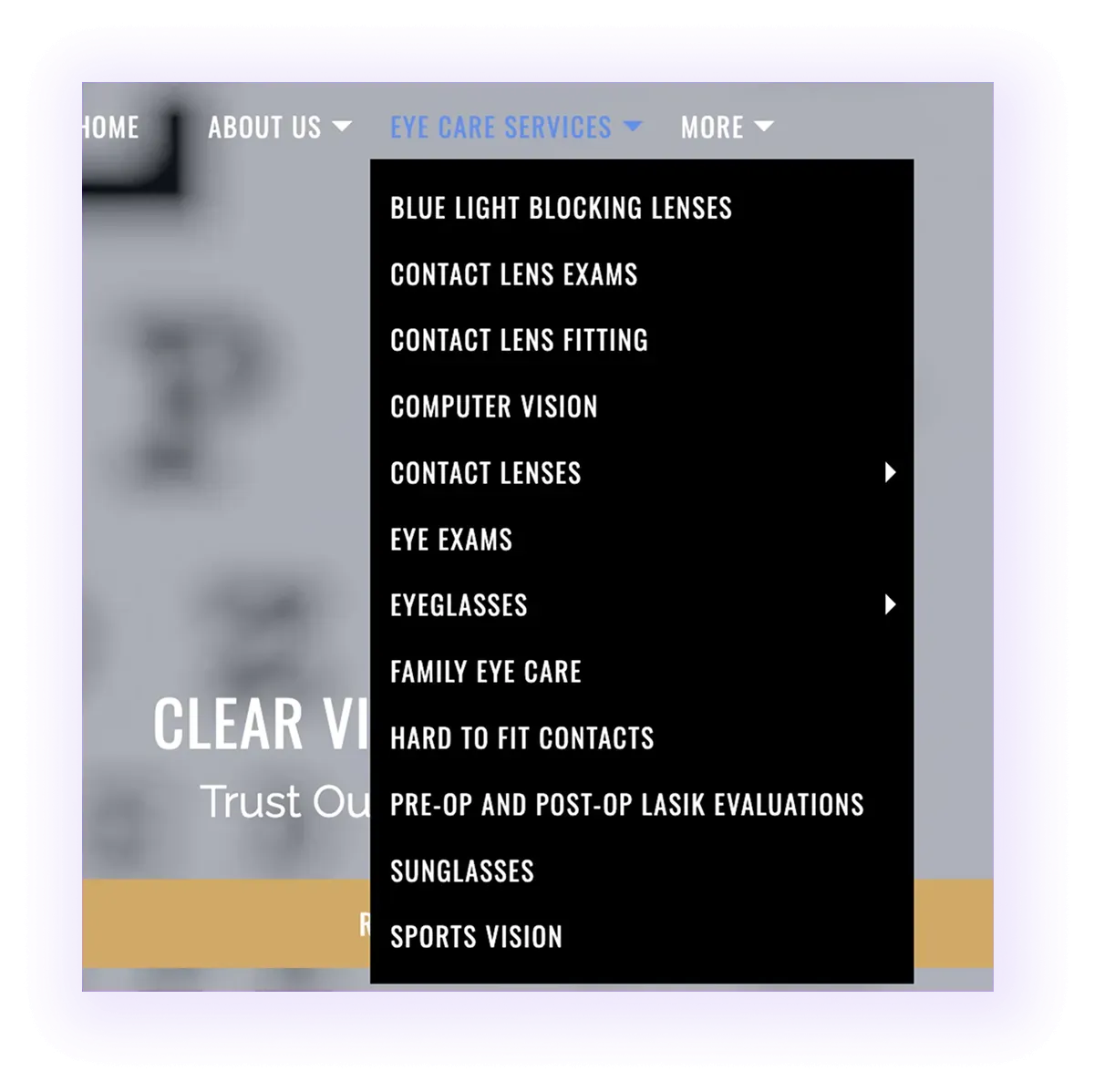
Place these pages under your “Eye care services” menu so patients can find what they need without having to dig through your site.
Pages for Your Optometrists and Doctors
Google treats medical content with extra scrutiny because it can affect someone’s health. This is known as “Your Money, Your Life” (YMYL), and it means your site needs strong proof that real, qualified doctors stand behind your advice.
One of the best ways to show this is by creating a dedicated profile page for each optometrist in your clinic. These pages also help you show up when patients search for a doctor’s name, directing them to your site instead of third-party listings.
Add a “Doctors” or “Our optometrists” tab in your navigation that leads to a main directory page. List each doctor with links to profiles that include their training, experience, awards, and the treatments they handle to strengthen your SEO for optometrists.

Local Pages
Your keyword research will show which cities or neighborhoods have the highest search demand, terms like “optometrist san antonio,” “optometrist houston,” or “optometrist nyc.”
If you serve these areas, create a dedicated page for each one so nearby patients can find you when they search for eye exams or treatments.
Add these location pages to your navigation so visitors can quickly see where you operate.
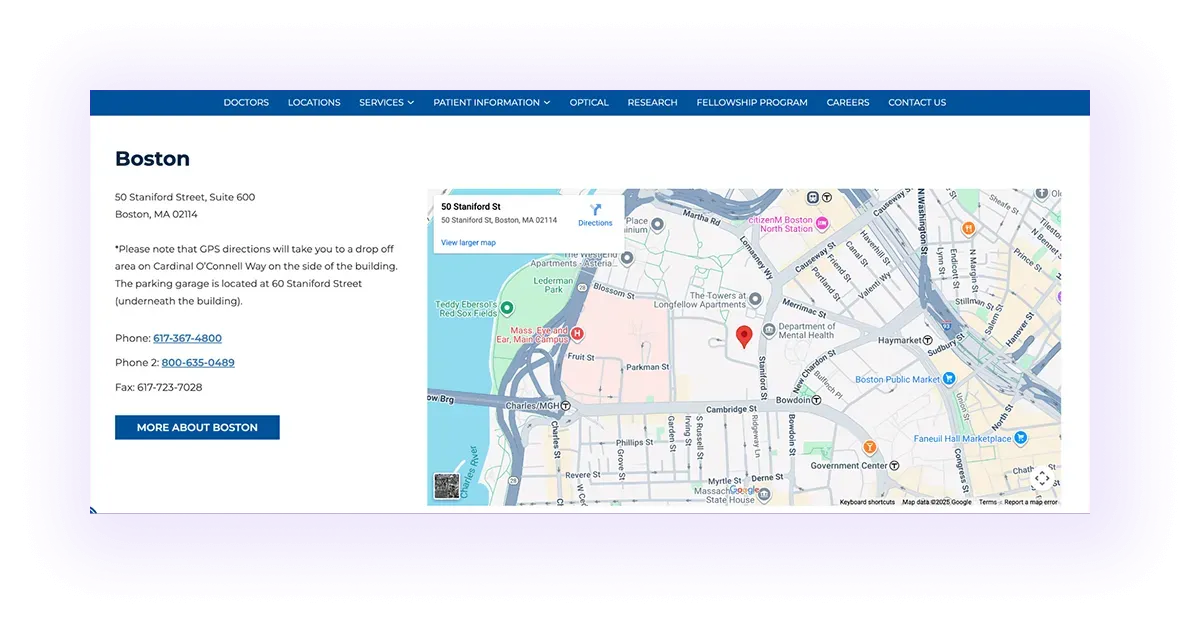
You can also include a simple “Locations” section that lists every clinic address and links to each page.
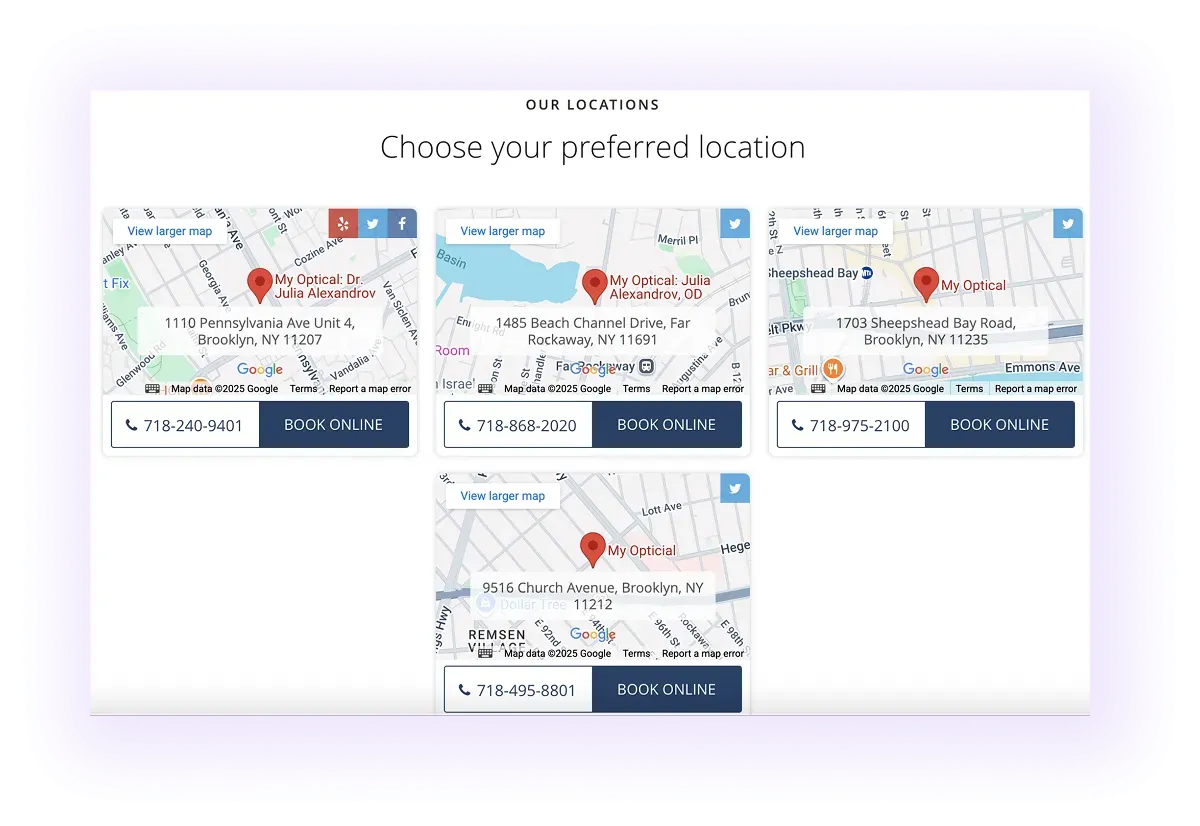
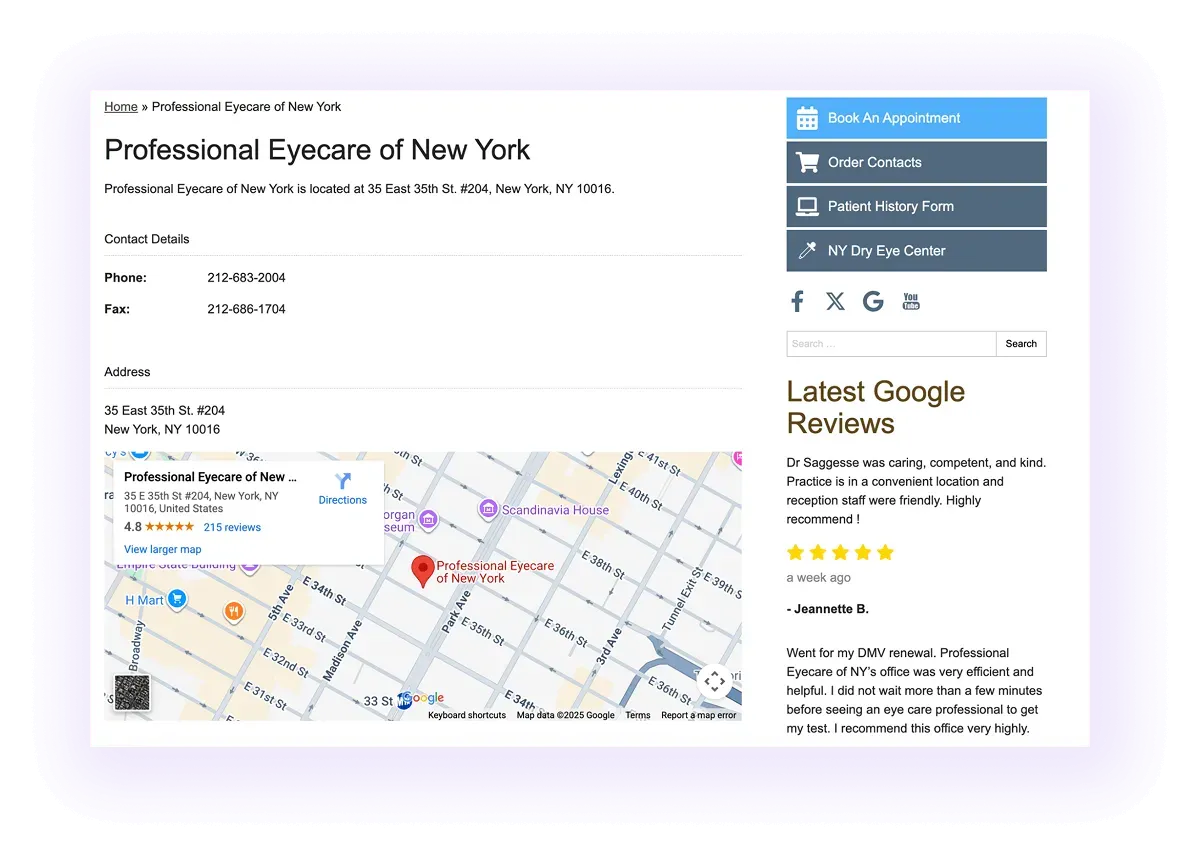
This is just the beginning of your . Later in this article, we will explain what else you can do to optimize your website for local searches.
Blog Pages
Many patients search for their symptoms before booking an exam. They look for answers to questions like:
- What causes dry eyes?
- Why is my vision blurry?
- How can I prevent eye strain?
Create blog posts that explain these issues in plain language. Walk readers through common causes, when to see an optometrist, and the treatments your clinic offers.
This positions your clinic as a trustworthy source and keeps your name top of mind when they or their family members need an exam or ongoing care.
Stop Guessing Your Optometry Website Structure—We Will Show You Exactly What Pages You Need
The outline is ready! Now it’s about putting it into action. If you want help from an optometry SEO agency that’s handled this for 40+ optometry clinics, reach out anytime. Let’s make sure your patients can find you.
How to Do Local SEO for Optometrists
When someone needs an exam, has new symptoms, or is considering something like LASIK, they rarely look beyond their own area. Searches usually sound like “optometrist near me” or “optometrist in san diego.”
Strong local signals are a major part of optometrist local search optimization because they help you appear in the map pack and reach patients ready to book. The setup varies slightly for single-location clinics vs. multi-location groups. Here’s how to optimize for both.
Local Optometric Clinic
If your clinic serves one area, like LA, your homepage should focus on local terms such as:
- optometrist los angeles
- optometric clinic los angeles
- optometric services los angeles
Your service pages should follow the same structure with phrases like:
- dry eye treatment los angeles
- diabetic eye exam los angeles
- lasik surgery los angeles
- pediatric eye exam los angeles
Use these terms in your titles, meta descriptions, and headings to strengthen local visibility and reach patients searching in your area.

National or Multi-Area Optometric Clinic
If your clinic serves multiple areas, create a separate page for each location. Target clear “service + location” phrases such as:
- optometrist in new york
- optometrist in la
- eye care in boston
- eye doctors in houston
Use these terms in your titles, meta descriptions, headings, and on-page text without repeating them too often. This structure strengthens SEO for optometrists across different regions.
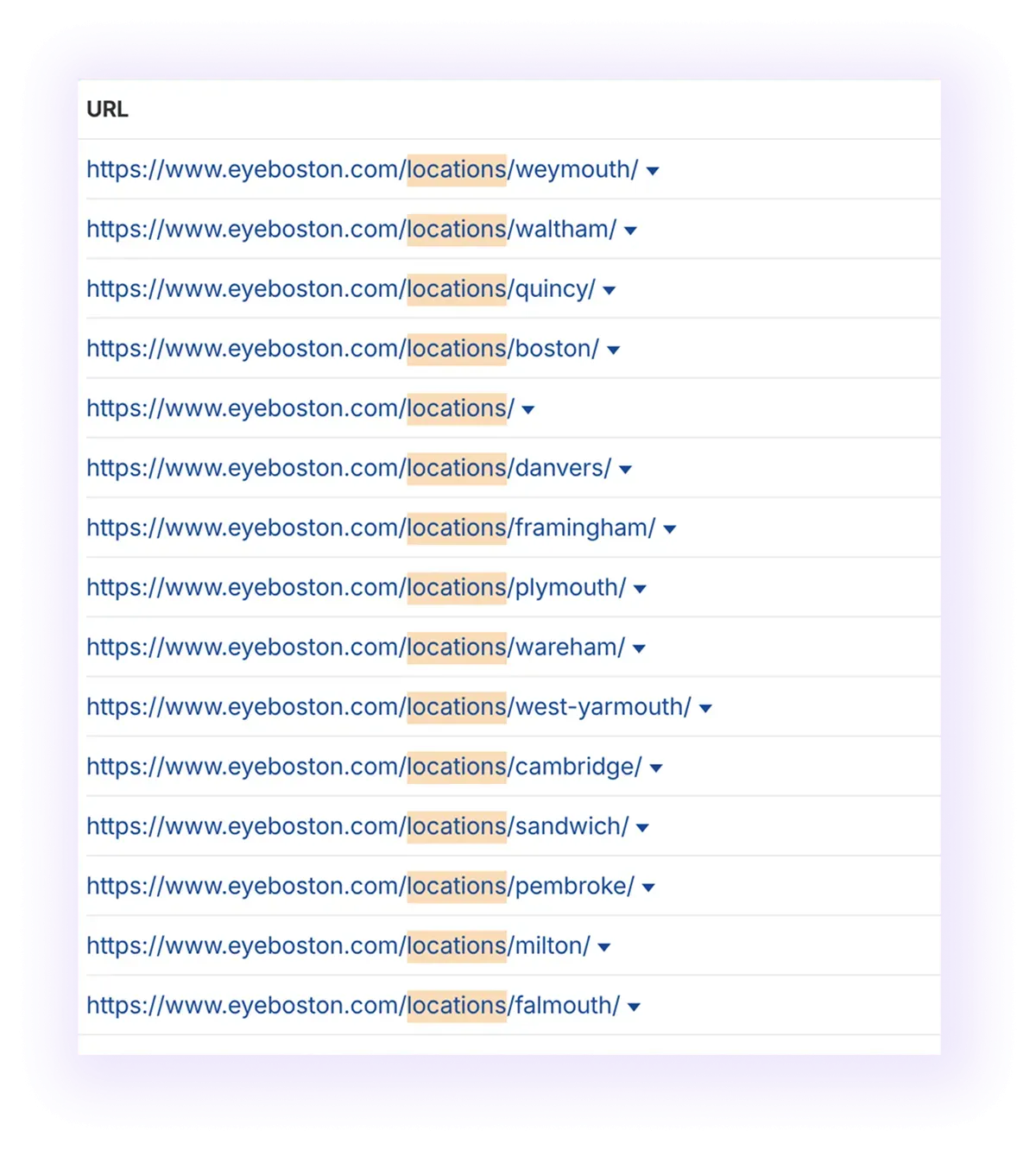
Make sure each page’s URL shows the location so visitors know they’re in the right place as soon as they land. You can place all location pages under a single “Locations” category to keep your site organized and easy to navigate.
Set up Your Google Business Profile and Optimize it for Google Maps
About 84% of patients read online reviews before choosing an optometrist, which makes your Google Business Profile one of your most important local assets.
Here’s how to get your Google Business Profile in shape:
- Match your phone number, address, and business name exactly as they appear on your website.
- Write a clear description that highlights your services and specialties.
- Add your website URL.
- List your treatments in the products/services section, such as eye exams and family eye care.
- Ask patients for reviews and respond to all feedback with a professional tone.
- Monitor the Q&A section and answer questions promptly.
- Upload high-quality photos of your doctors, clinic interior, and equipment.
- Link your social media profiles.
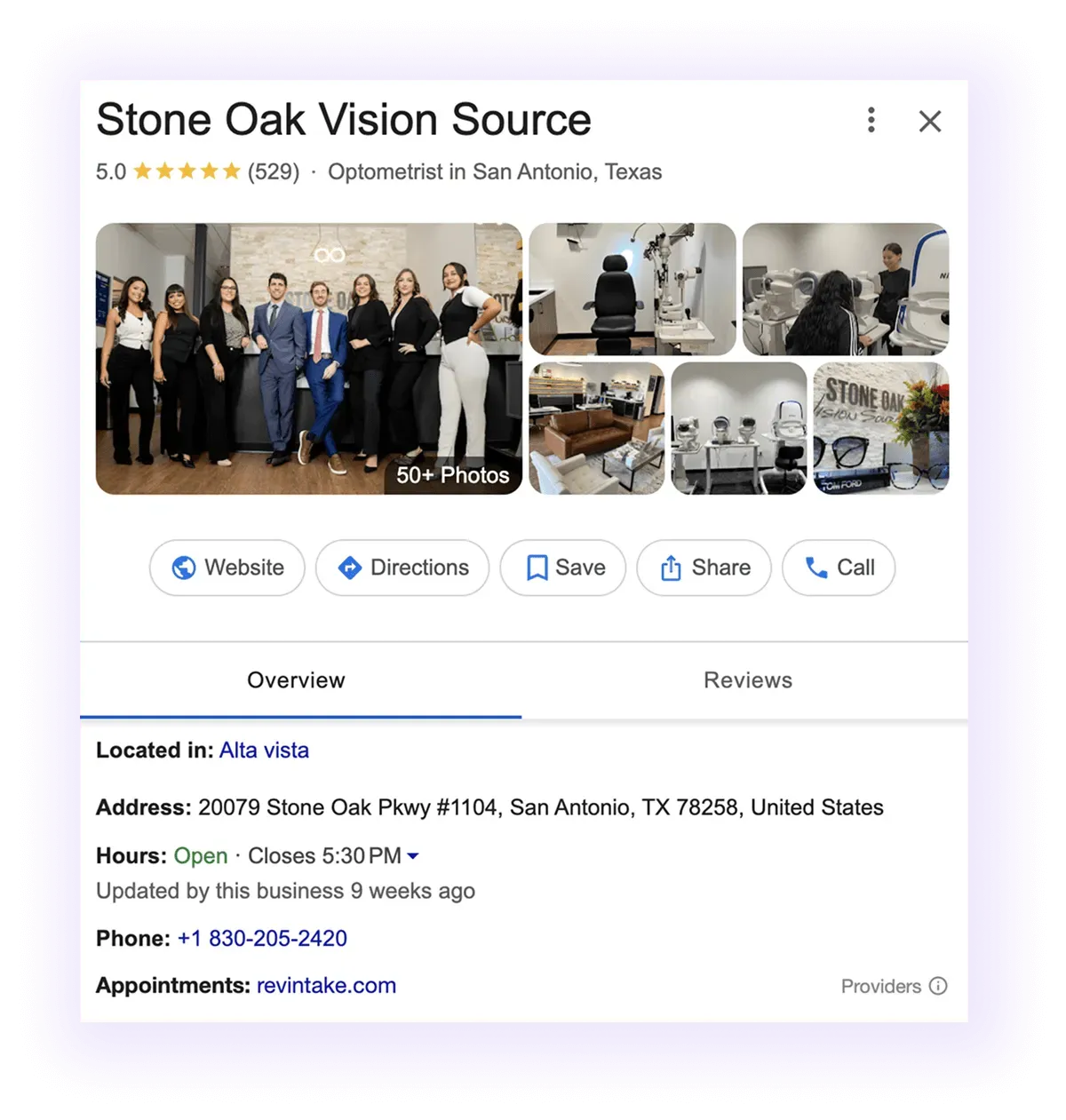
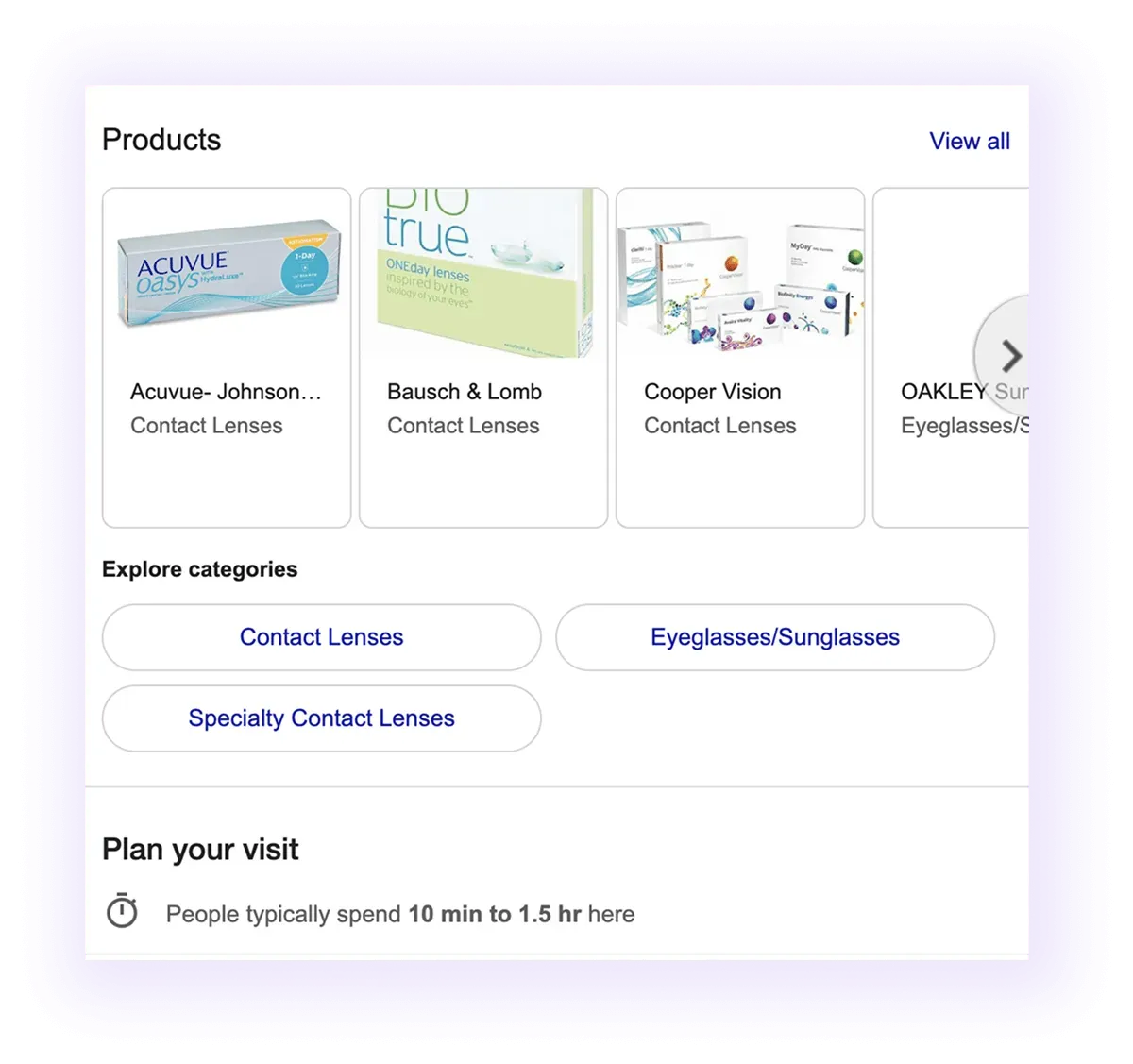
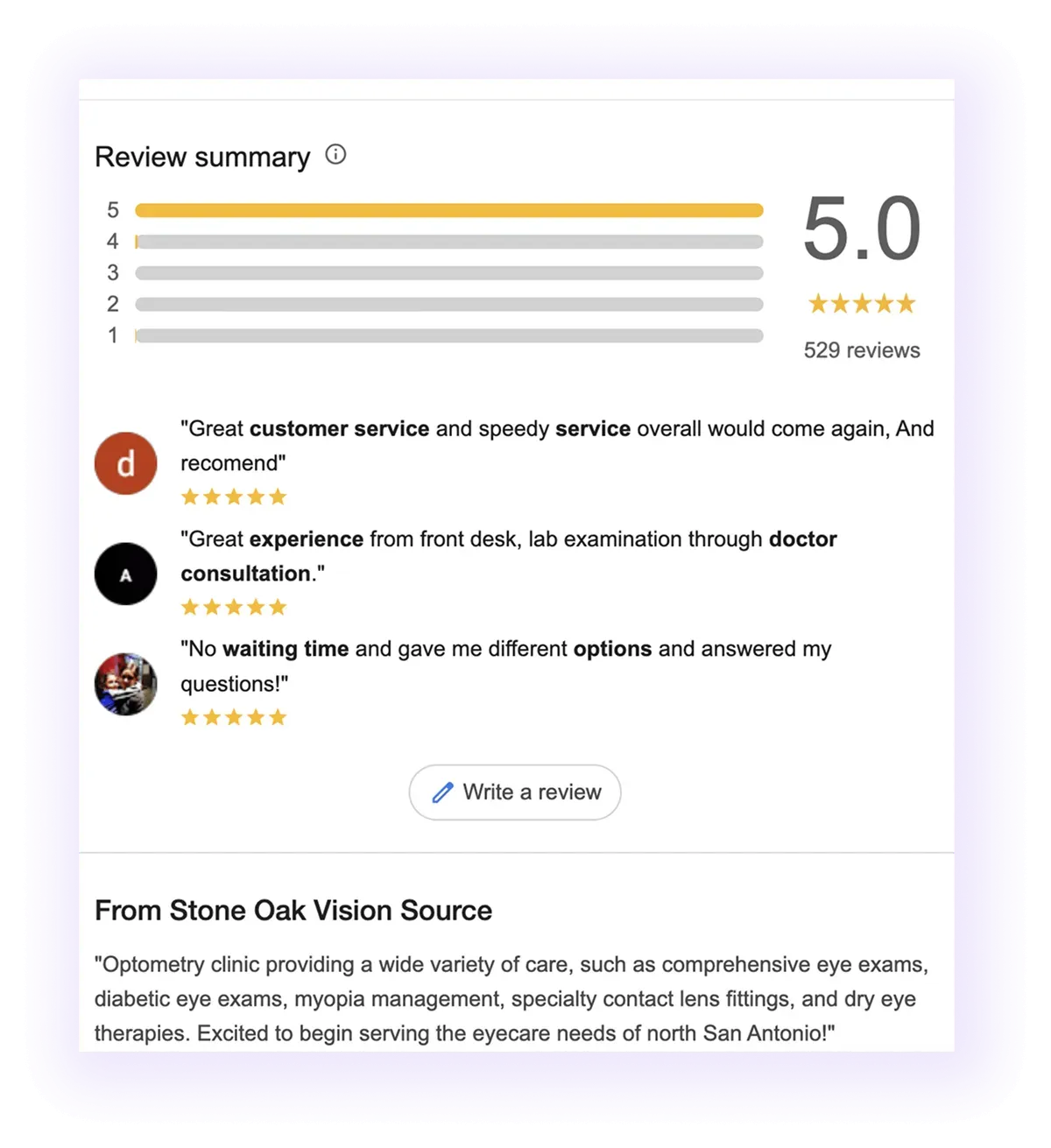

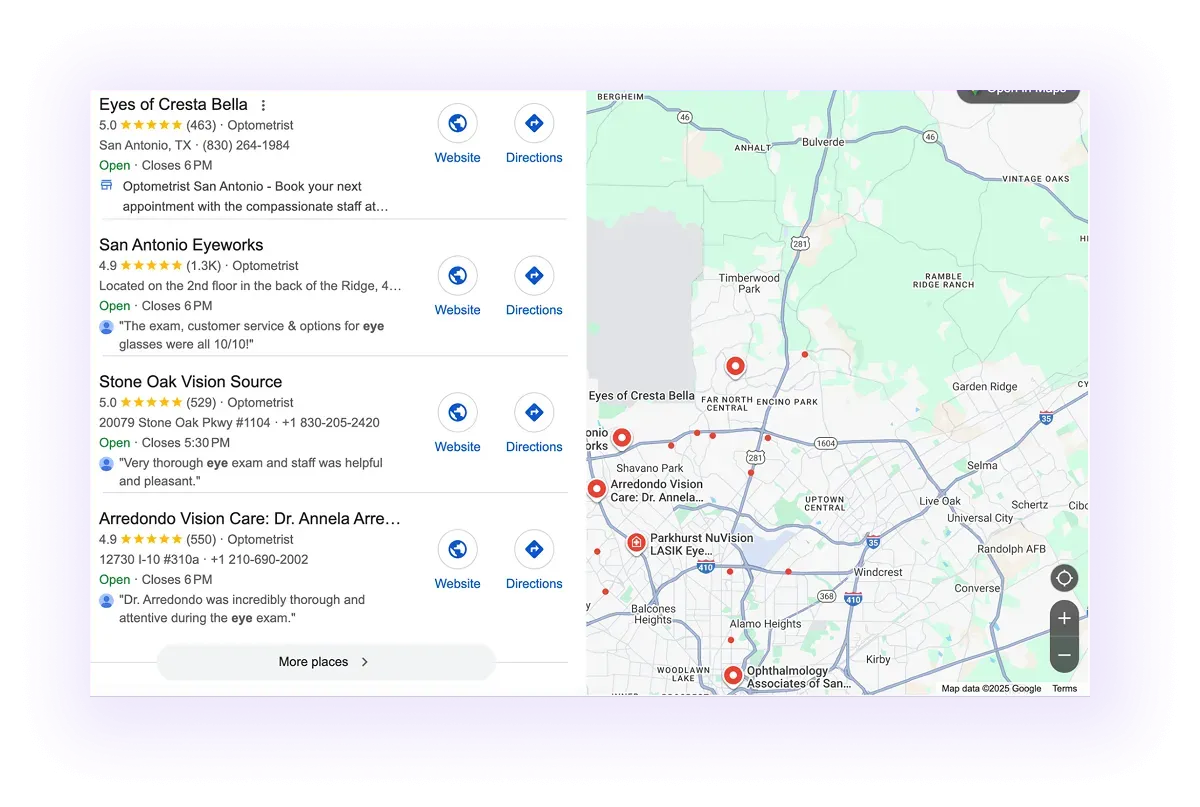
Once your profile is fully optimized, it has a much better chance of appearing in the map pack, an essential advantage for optometrist SEO when patients search locally.
Build High Quality Content for Your Optometric Website
Your location and service pages will rank only if the content is helpful, original, and clearly written for patients (you can check this using our free readability score checker). Keep every page unique, use your keywords naturally, and structure your headings from H1 to H4 so Google can read the page without confusion.
Because optometry falls under Google’s YMYL standards (crucial in medical SEO), your site also needs strong trust signals. Add elements like:
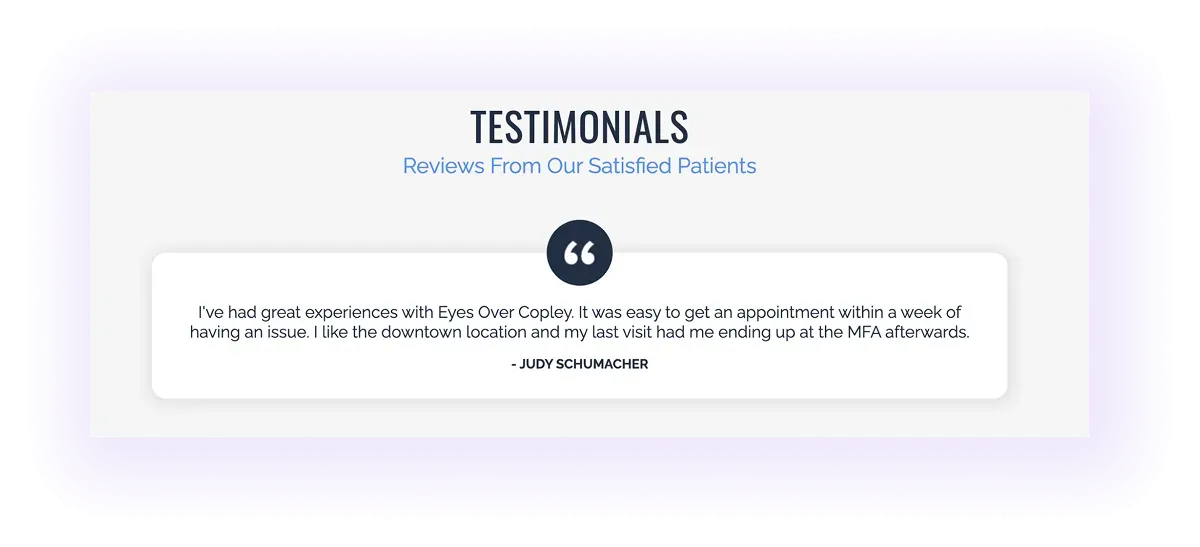
- Testimonials: Real patient stories that show the quality of your care.
- Doctor Bio Section: A hub that links to full profile pages, highlighting training and qualifications.

- CareCredit or Financing Options: Clear notes about payment plans so patients know affordable options exist.

- Products (Glasses or Lenses): Details on frames, contacts, or lens options available in your clinic.

- Featured Eyewear Brands: Well-known brands that help patients feel confident in your selection.

- Special Offers: Discounts or bundles, such as frame-and-exam packages, to encourage more bookings.

- Programs and Seasonal Promotions: Any ongoing patient programs or seasonal promotions that support return visits.

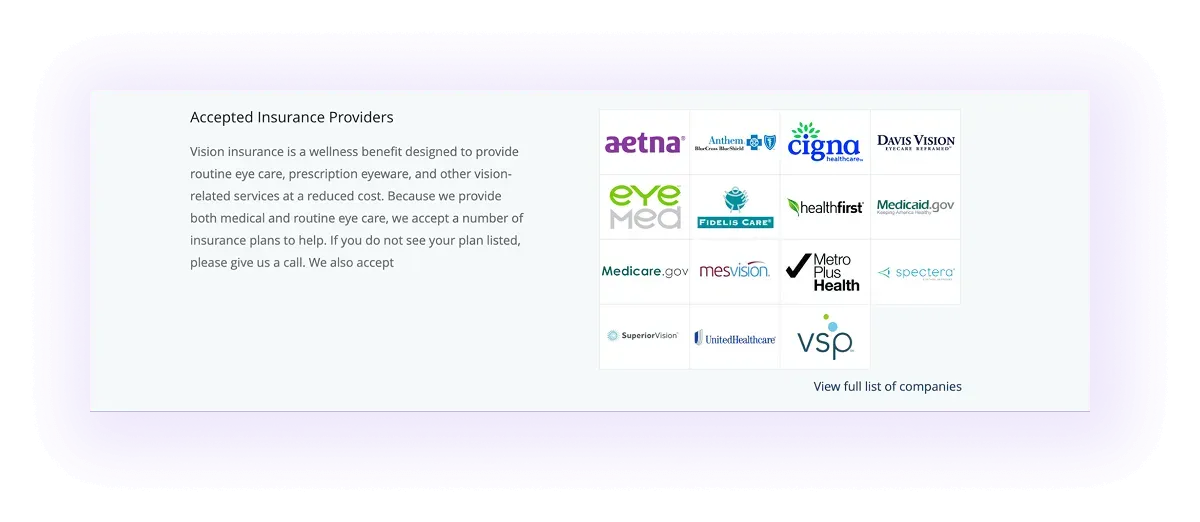
- Accepted Insurance Providers: A full list of the plans you take so that patients can confirm coverage quickly.
Blog Posts
Blog posts help you capture question-based searches like “why are my eyes always dry” or “how often should I get an eye exam.”
To make these posts support your rankings, use an organic content strategy for SEO called pillar clustering.
This approach starts with a primary service page keyword, such as “dry eye treatment,” and builds supporting blog posts around it. These posts link back to the main page, strengthening its topical depth. Good cluster ideas include:
- Can dry eyes cause blurry vision?
- Is screen time causing my dry eyes?
- Best home remedies for dry eye relief
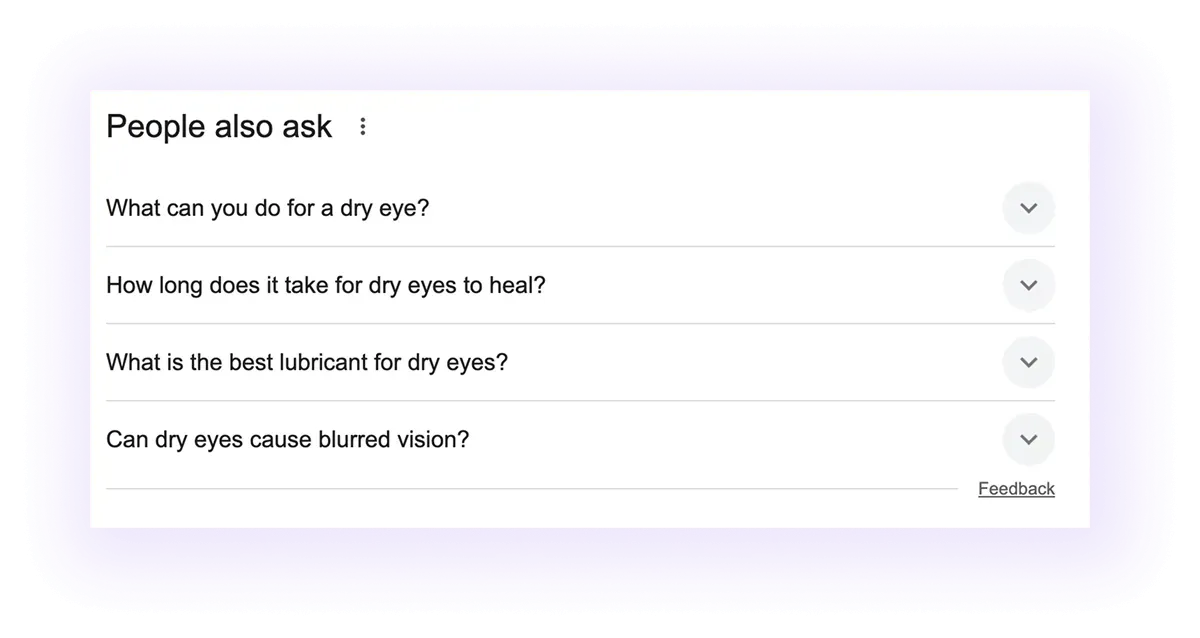
This method works well for optometry SEO because it helps Google understand your expertise around each condition or treatment. Tools like Ahrefs’ Questions section, Google’s “People also ask,” and competitor blogs can help you find cluster topics.
To help your blog posts rank:
- Keep every article original and avoid copying ideas from other clinics.
- Use simple, readable language that patients can follow.
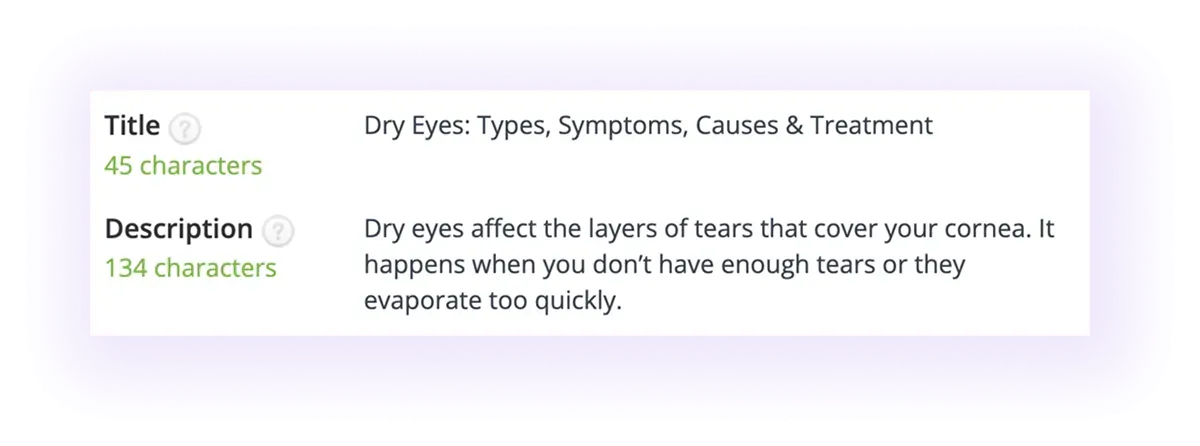
- Place your keywords naturally in the title, headings, and meta descriptions.
- Add insights from your doctors to strengthen credibility.
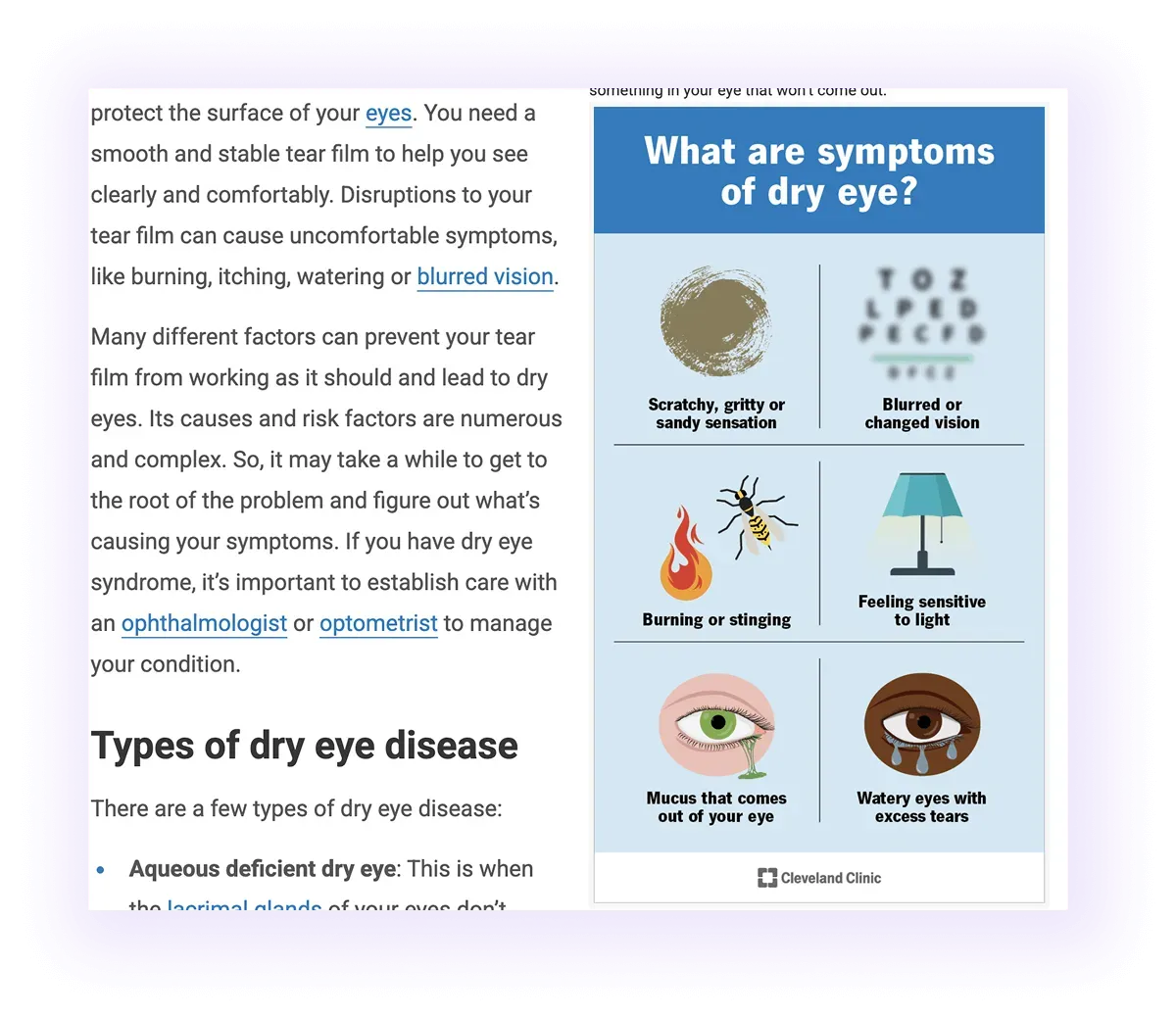
- Include photos or videos when they add clarity.
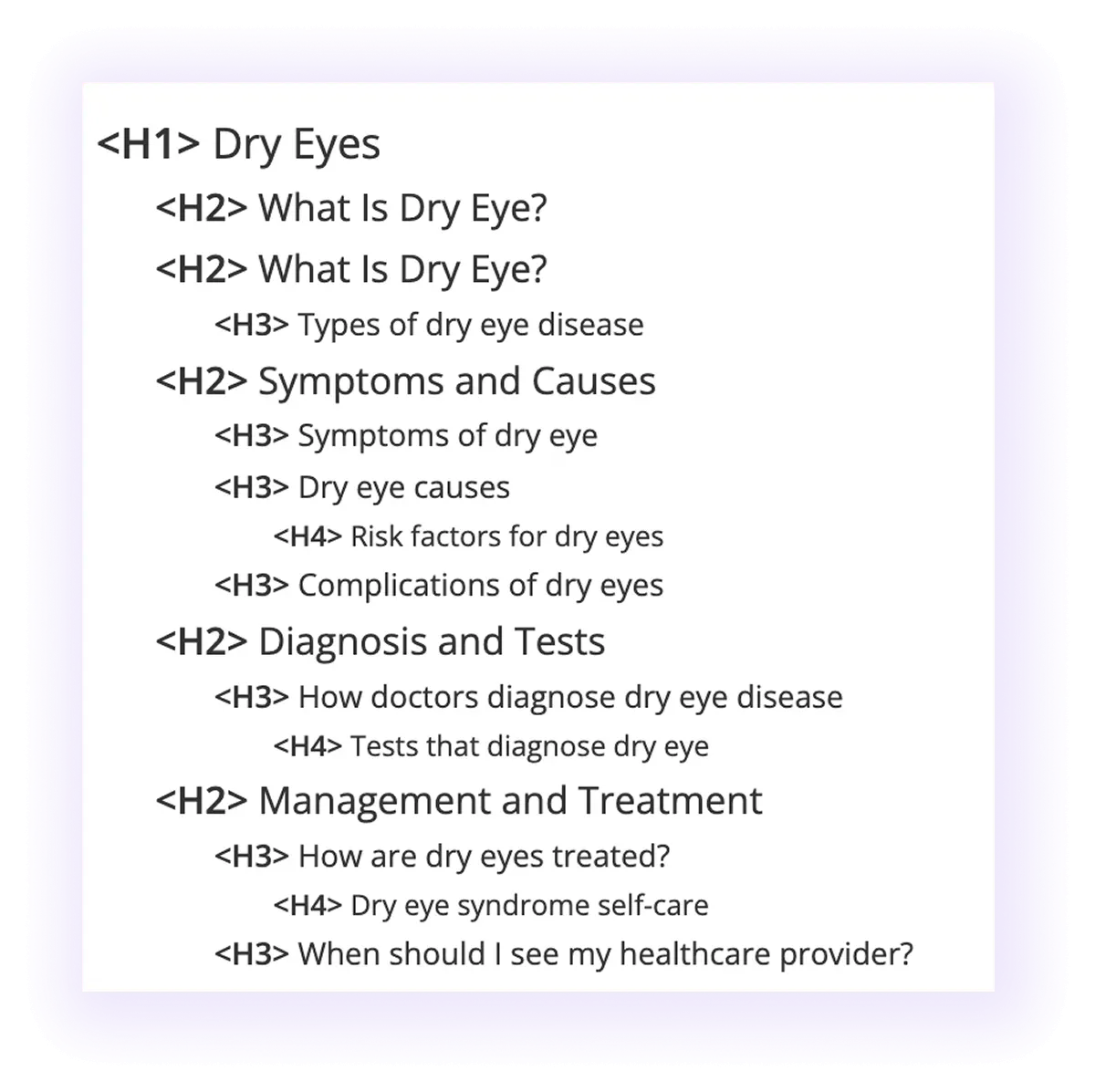
- Follow a clean H1-H4 structure.
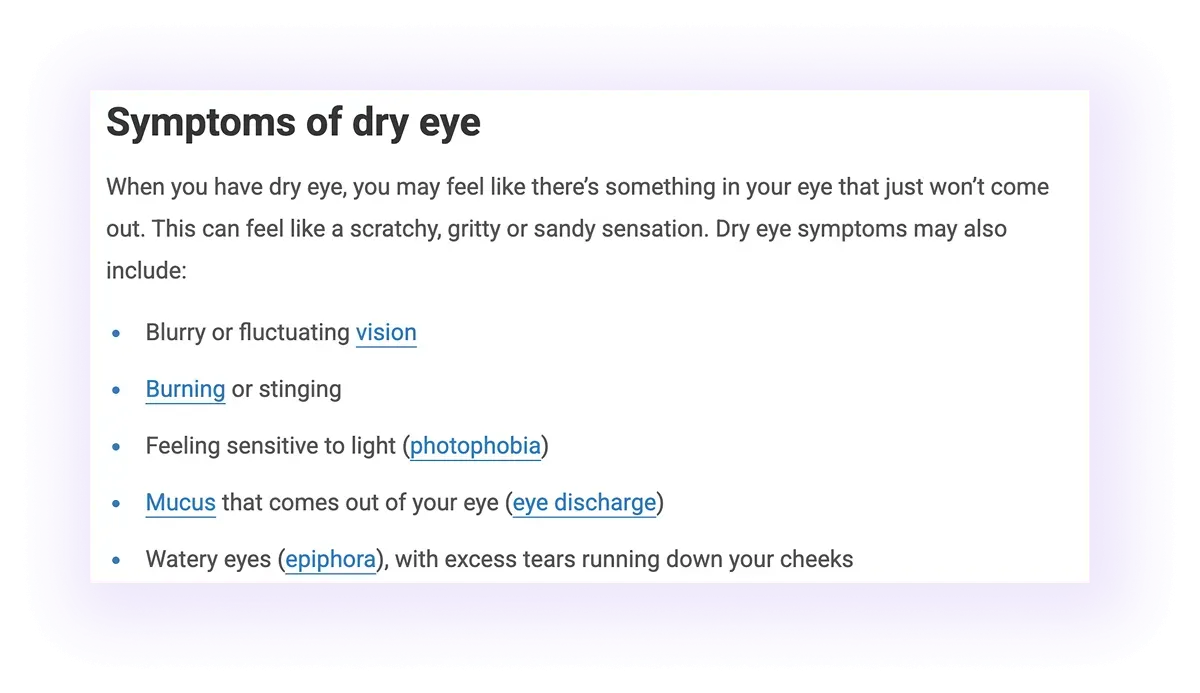
- Cite all data or statistics to meet YMYL expectations.
- Use lists or tables when they make complex explanations easier to understand.
Implement Technical SEO for Your Optometric Clinic
Now it’s time to ensure Google can crawl, index, and read your website correctly, and that your site loads quickly and feels easy to navigate for every patient.
XML Sitemap and Robots.txt
Your technical optimization checklist starts with an XML sitemap and robots.txt file. An organized XML sitemap helps Google find and index your right pages, including your homepage, service pages, doctor profiles, blogs, and location pages. It also supports stronger SEO for optometrists by making your site easier for Google to read.
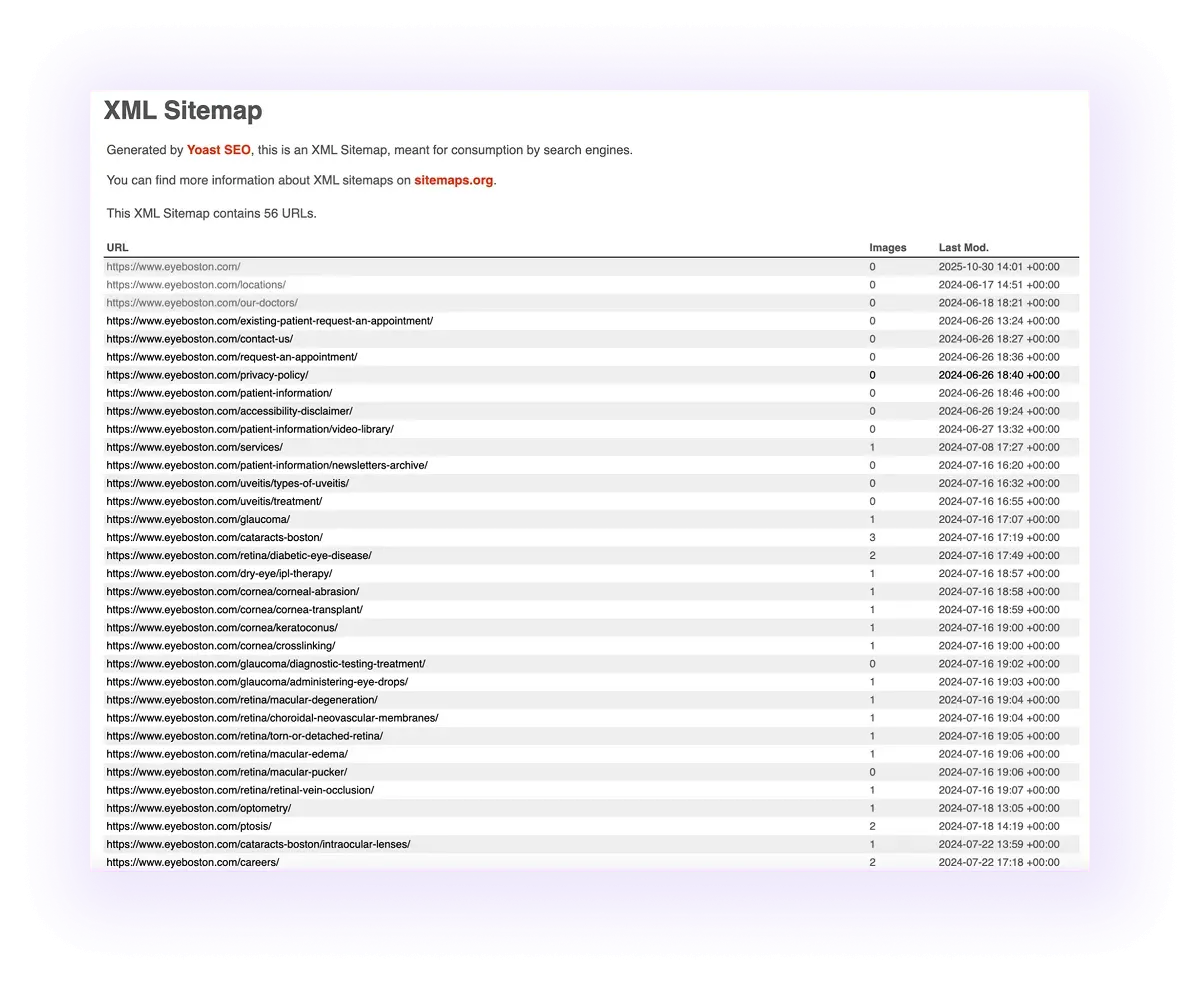
If you have pages with thin or duplicate content, or any patient-specific pages you don’t want indexed, block them in your robots.txt file so they stay out of search results.
Schema Markup and Structured Data
Schema markup helps Google pull details from your site, such as services, FAQs, ratings, and doctor information, and display them directly in search results. This makes your pages easier for Google to understand and increases the chance of earning rich snippets.
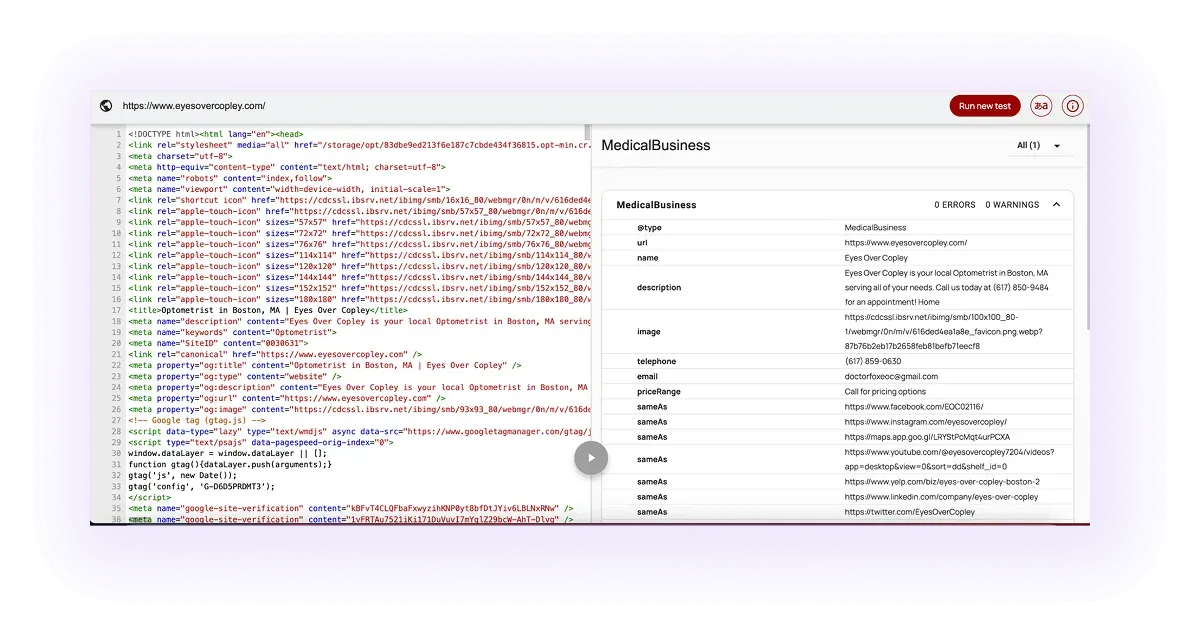
Use the following schema types on an optometric website:
- MedicalBusiness / MedicalOrganization: Identifies your clinic as a medical provider offering exams, treatments, and optical services.
- FAQ Schema: Let your questions and answers appear as expandable results.
- AggregateRating: Shows your star rating and total review count to build trust and improve clicks.
- LocalBusiness: Sends Google your name, address, phone number, hours, and service area to improve your local reach.
- Physician (Person) Schema: Provides detailed information for each optometrist so their profiles can appear in search results.
- BreadcrumbList: Helps Google read your site structure and display breadcrumb paths in search listings.
URL Structure
A clear URL structure helps visitors understand where they are on your site and makes it easier for Google to read your hierarchy. Keep URLs descriptive, use hyphens between words, and avoid random characters or numbers.
- Good SEO URL: www.example.com/eye-care-services/dry-eye-treatment
- Bad SEO URL: www.example.com/p=4839x?dryeye123
Internal Link Building for Optometric Websites
A strong internal linking structure helps patients move through your site and passes authority from well-ranking pages to service pages that need a boost. This improves navigation and supports your overall optometrist SEO strategy.
Below is a table outlining the main internal link types to use on an optometry website:
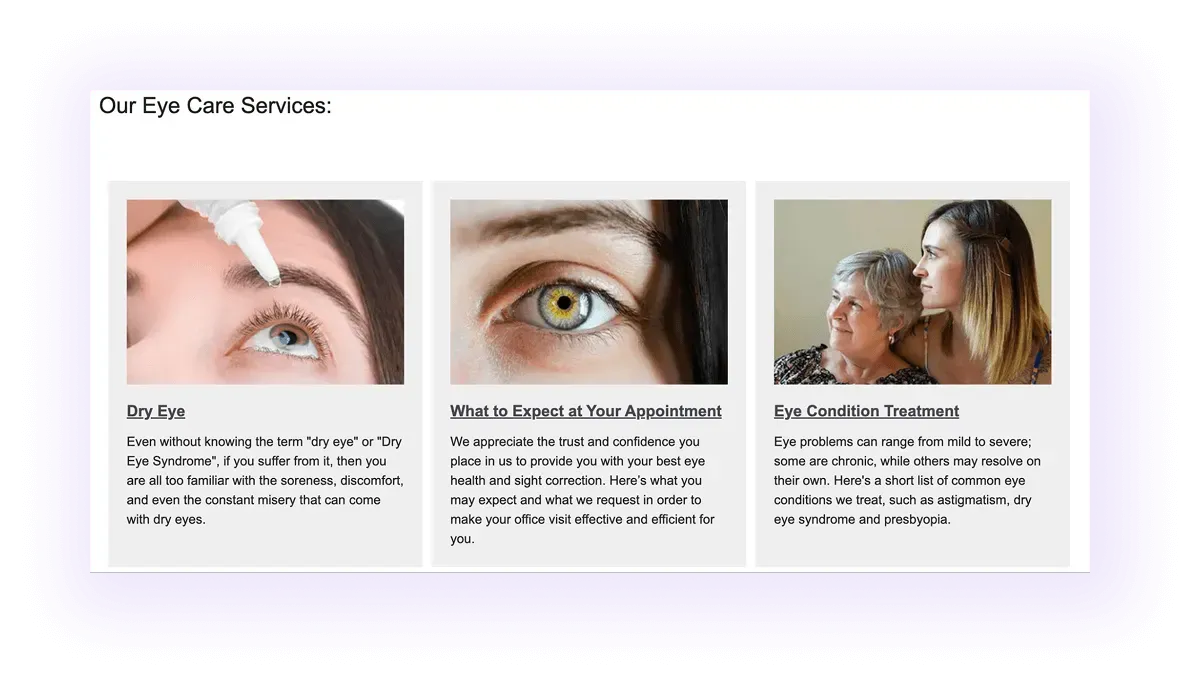
- Navigation Links: Help users and Google reach your core pages. For example, the menu links to About Us, Contact Us, Eye Care Services, Treatments, and Doctors.
- Blog-to-Blog Links: Connect related topics to keep readers engaged and strengthen topical depth; for example, a winter dry eye post links to a post on the causes of chronic dry eye.
- Blog-to-Service Links: Pass authority from educational content to service pages and guide readers toward booking. For instance, a screen-time strain article links to the dry eye treatment page.
- Service-to-Service Links: Show how treatments relate to one another and help patients explore more options; for example, the dry eye treatment page links to meibomian gland dysfunction.
- Service-to-Location Links: Improve local relevance by pairing services with the areas you serve; for instance, the eye exam page links to eye exams in San Diego.
- Service-to-Doctors Links: Build trust by connecting treatments to the doctors who provide them; for example, the myopia control page links to the treating doctor’s profile.
Mobile Optimization for an Optometric Clinic Website
Most patients search for eye care on their phones, whether they’re dealing with dry eyes, blurry vision, or considering LASIK. Your site needs to work well on smaller screens because mobile usability is a strong ranking factor.
To make your site mobile-friendly:
- Use a responsive design so the layout adjusts to any screen size.
- Compress images to keep load times fast.
- Use large, easy-to-tap buttons.
- Keep text readable with a minimum font size of 16px.
- Add a simple hamburger menu for mobile navigation.
- Include clear call-to-actions, including click-to-call buttons so that patients can reach you quickly.

Website Speed & Performance (Core Web Vitals)
Fast load times matter for both rankings and patient experience. If someone searches for dry eye treatment or eye exams, they won’t wait for a slow site; Google won’t either. To improve speed on your optometry website:
- Compress and optimize large images.
- Use lightweight videos.
- Choose a reliable hosting provider and add a CDN.
- Use server-side rendering for complex pages.
- Add lazy loading so images appear only when users scroll.
- Clean up your JavaScript, CSS, and HTML.
After updating these areas, test your site with Google PageSpeed Insights or GTmetrix.
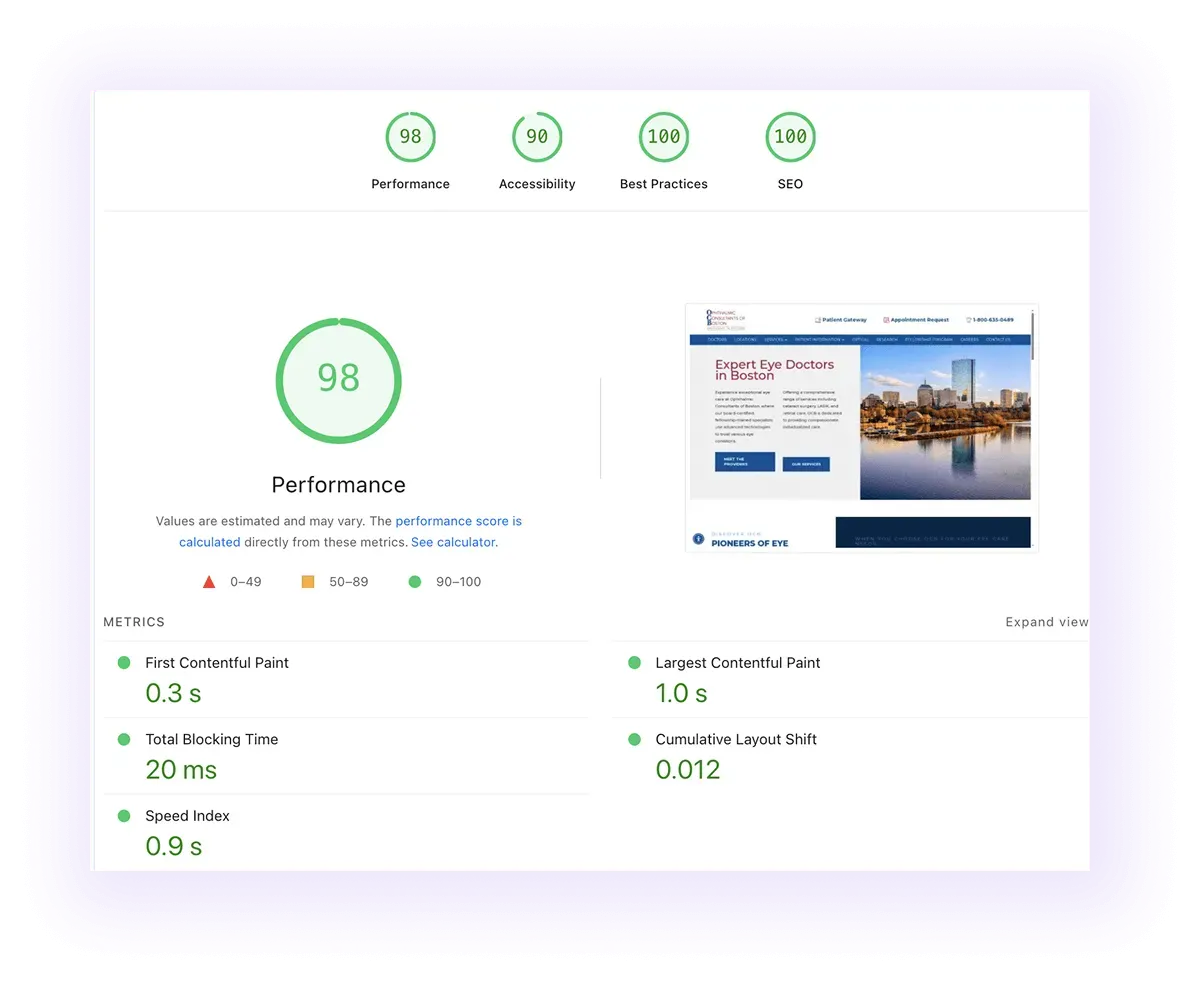
Monitor these key metrics:
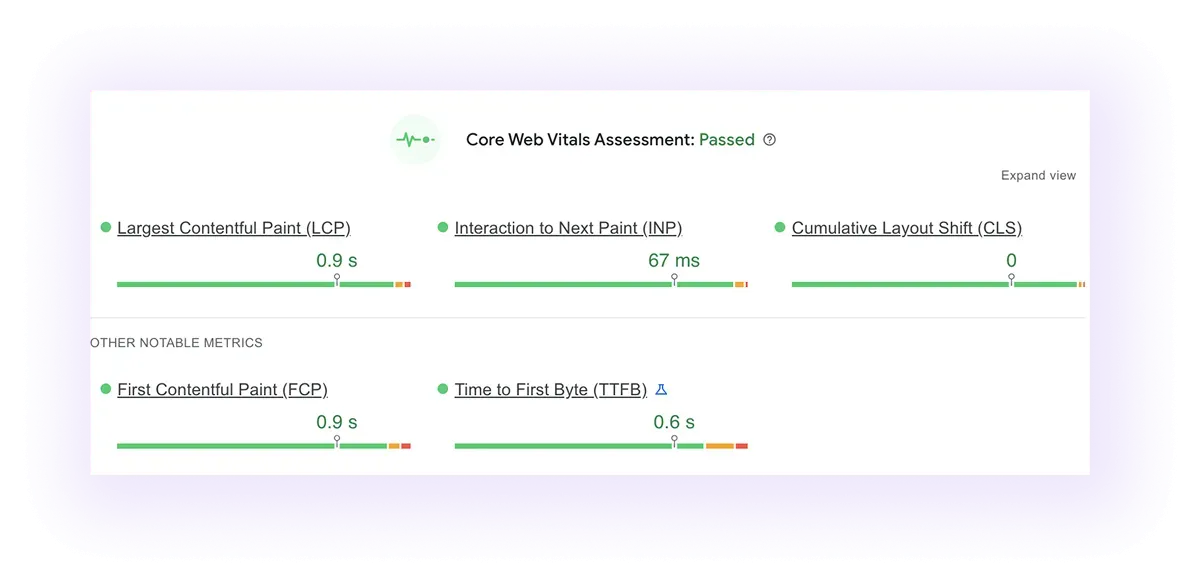
- Largest Contentful Paint (LCP): Under 3 seconds
- First Contentful Paint (FCP): Under 1 second
- Cumulative Layout Shift (CLS): 0
Frequent Technical Audits
As your clinic grows, you’ll add new treatments (glaucoma care, oculoplastics, cosmetic services, retina care) and possibly new locations. Each update can influence how your site performs, so running monthly technical audits keeps everything in good shape. During each audit, review:
- Redirect Errors: Use Screaming Frog or Ahrefs to spot and fix faulty redirects.
- Duplicate Content: Check with Copyscape or Screaming Frog and remove repeated pages.
- Broken Links and 404s: Scan with Screaming Frog.
- Indexing Issues: Confirm indexing in Google Search Console.
- Mobile Usability: Review with PageSpeed Insights and Search Console.
- Crawl Errors: Ensure Google can access all required pages.
- Core Web Vitals: Track LCP, FCP, and CLS in PageSpeed Insights.
- Schema Validation: Test with Google’s Rich Results tool to confirm everything fires correctly.
If you’d rather not manage these checks yourself, our optometrist SEO team can run recurring tech audits and quietly handle fixes in the background!
Link Building for Optometry Websites
Your site also needs authority, which comes from earning backlinks from trusted, relevant websites. There are three main ways to build these links, and we’ll walk through each one below.
Guest Posting and Link Insertion
A strong backlink profile supports your overall SEO for optometrists, so start by finding sites related to eye care, health, and eyewear. Examples include:
| Type | Example Site |
|---|---|
| Health Care Websites | healthline.com |
| Medical Websites | medicinenet.com |
| Glasses Websites | warbyparker.com |
| Lens Websites | contactlensking.com |
| Dermatology Products | dermstore.com |
Once you identify relevant sites, choose between two backlink strategies:
- Guest Posting: Write a new article tied to your services, contact the editorial team, and request publication with a backlink. For example, “Tips for managing dry eye syndrome” links to your dry eye treatment page.
- Link Insertion: Find an existing article, add fresh insight or updated data, and request that the editorial team insert a link back to your site. For example, add commentary on pediatric myopia management to a blurry vision article and request a link to your myopia control page.
Directory Listings for Optometric Clinics
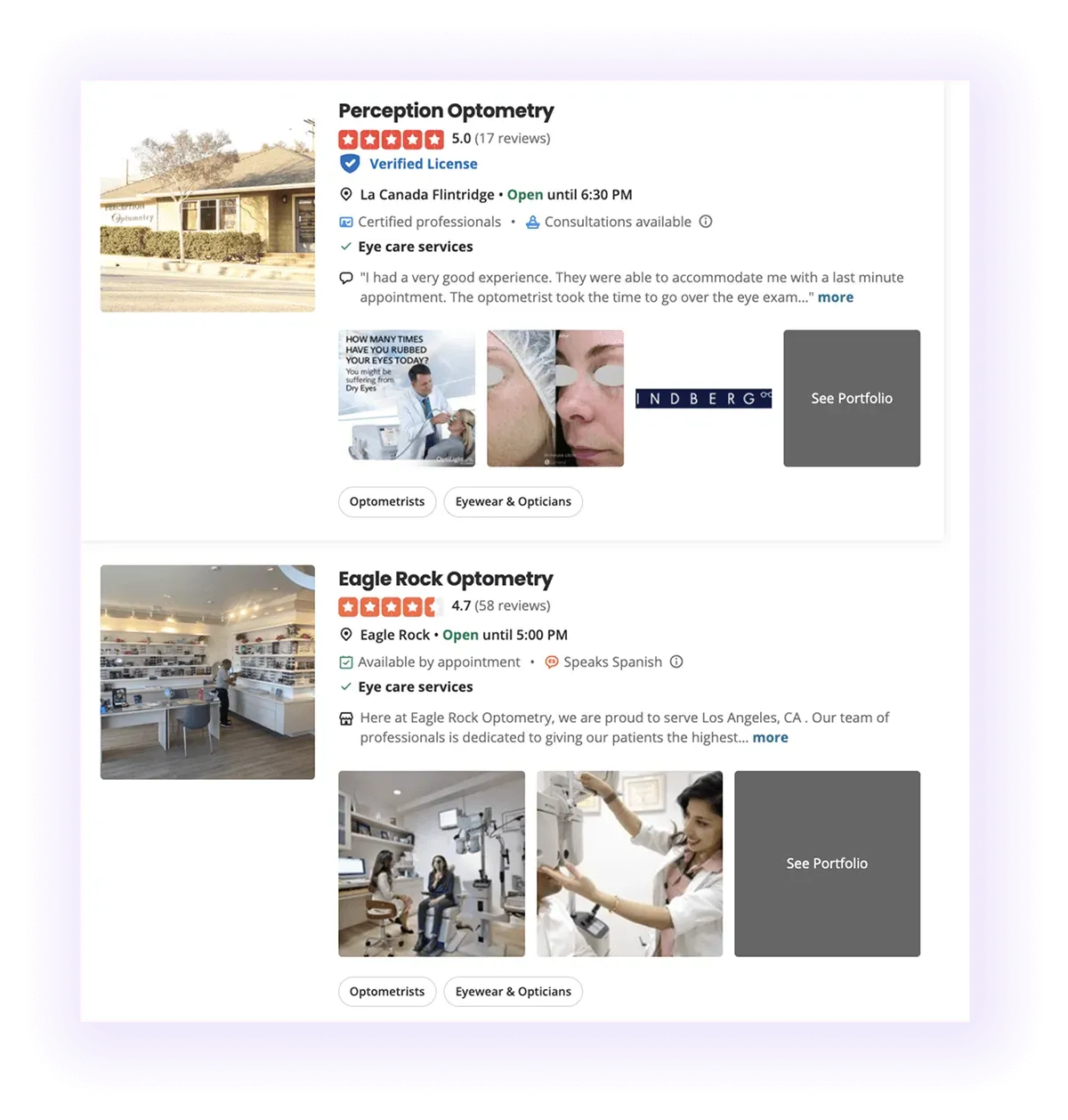
Adding your clinic to reputable directories is another effective way to earn backlinks and help patients find you. Examples include:
| Directory Type | Example |
|---|---|
| Optometry Directories | americanboardofoptometry.org |
| Doctors Directories | vitals.com |
| Local Business Directories | yelp.com |
When doing location-focused link building:
- Use the same clinic name, address, phone number, and logo as your website and Google Business Profile.
- Write a clear description that highlights your services and treatments.
- Upload photos of your doctors, including training and awards.
- Add before-and-after images when appropriate.
- List all treatments you offer, including specialty services.
- Reply to reviews to stay engaged with patients.
- Include your website URL so visitors can reach you easily.
Digital PR for Optometry Websites
Digital PR is a powerful way to earn high-authority backlinks by getting featured on major news sites like Forbes and industry outlets like Optometry Times. To make this approach work:
- Choose a Newsworthy Topic: Pick something timely and relevant to eye care, for example: “The rise of childhood myopia during increased screen time.”
- Gather Reliable Data: Use clinic insights, doctor input, or patient surveys to support your topic.
- Write a Clear Article: Keep it organized and easy for journalists to understand at a glance.
- Craft a Short Pitch: Explain how you gathered the data, why the topic matters, and what readers will learn.
- Reach Out to The Right Reporters: Contact journalists who cover health or optometry. If your angle fits their beat, they may feature your piece and include a backlink to your site.
How to Track the Success of Your Optometry SEO Strategy
Once your on-site and off-site work is in place, track your results regularly. Focus on these metrics and analytical tools:
- Keyword Rankings and Movement: Monitor indexing, impressions, clicks, and visibility in Google Search Console.
- Backlink Profile and Competitor Checks: Review your links and compare with competitors using Ahrefs or SEMrush.
- Website Speed and Performance: Test with Google PageSpeed Insights.
- Traffic, User Acquisition, and Conversions: Analyze this in Google Analytics to see what channels drive results.
- User Behavior: Use Microsoft Clarity or Hotjar to review heatmaps, scroll depth, and click patterns.
- Event Tracking: Set up Google Tag Manager to track form submissions, calls, and button clicks.
Partner with an Optometry SEO Company That Knows Your Industry
As online competition grows, your clinic needs to stand out where patients are searching. Our optometry SEO work is built to increase local visibility and bring more patients to your site.
Let’s connect and map out an optometrist SEO plan that gets your clinic the attention it deserves!
Submit the form - Get Free Proposal
%202.png)
24 hours
FAQ


Submit the form - Get Free Proposal
24 hours
.svg)