.svg)
Project Overview
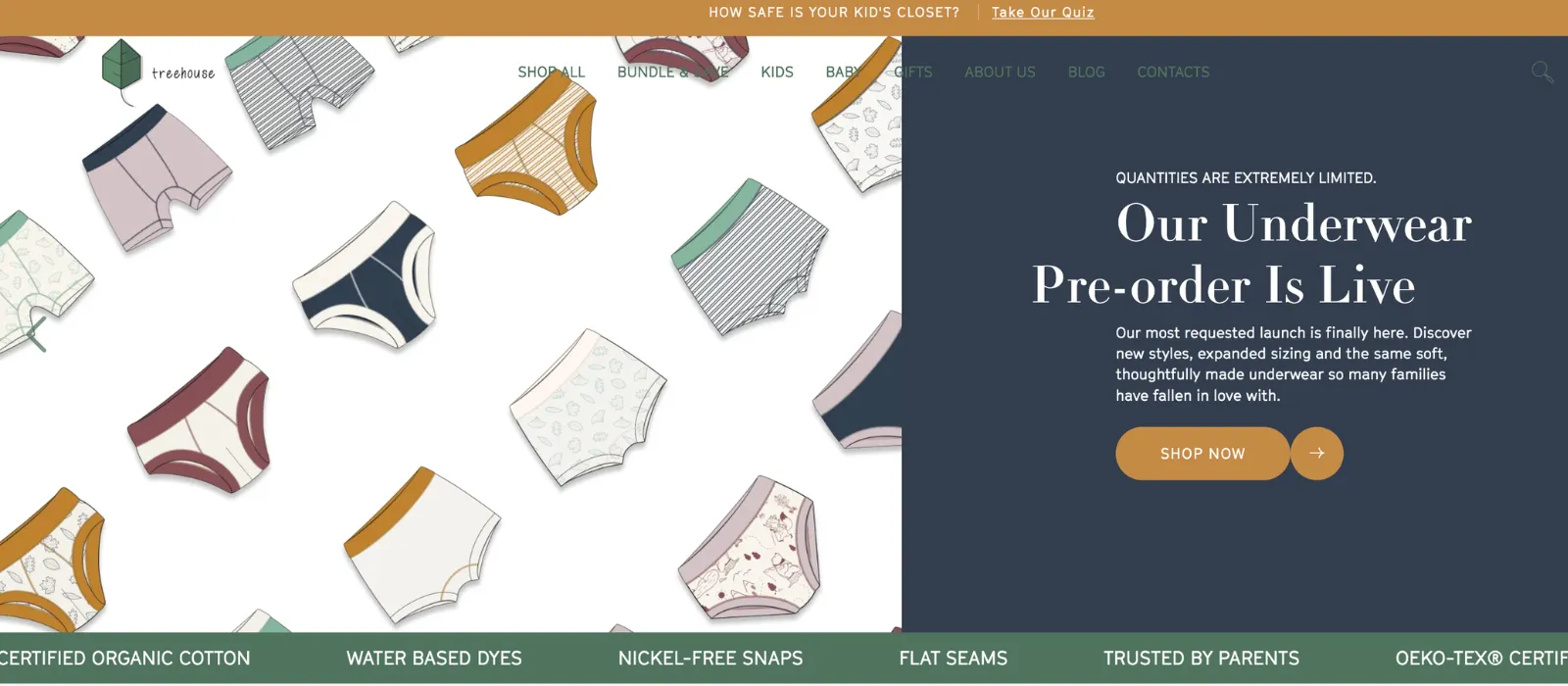
In April 2025, Loopex Digital provided SEO services for Treehouse, a direct-to-consumer eCommerce kidswear brand on Shopify that makes baby and children's clothing from GOTS-certified organic cotton and OEKO-TEX certified linen.
Goal
At the start of the project, the kidswear eCommerce store faced three problems:
- Almost no organic traffic. The store was receiving only around 150 organic visitors per month, so search was contributing almost nothing to revenue.
- Very limited keyword visibility. The website ranked for just 32 keywords in Google's top 10, which means it was invisible for the commercial searches parents use when they are ready to buy.
- Low domain authority. As a newly opened website, it had no authority to compete against national retailers and established parenting publishers.
Our SEO team set three goals, each aimed at one of these problems. First, build topical authority around organic and non-toxic kidswear to bring in the organic traffic the store was missing. Second, make the collection and product pages competitive so they would rank in the top 10 for commercial searches such as organic cotton kids' clothes, eczema clothing for kids, and kids' linen clothes. Third, raise the domain rating with relevant backlinks so the website had the authority to compete with larger retailers.
Solutions
Parents researching kids' clothing rarely start with a product search. They start with questions about fabric, chemicals, certifications, and skin sensitivity. Our SEO team built the Treehouse website to answer those questions, then connected every answer to the collection and product pages that sell.
We Built Three Content Clusters Around the Questions Parents Ask Before They Buy
Our content team published more than 40 blog articles and 10 long-form guide pages as part of our SEO content strategy.
- The first cluster covered fabrics and certifications: organic cotton compared with conventional cotton, bamboo, and muslin, what GOTS certification actually verifies, and whether cotton is renewable and biodegradable. These pieces gave the brand a place to explain the difference between an organic cotton claim and a certified supply chain, which is its main differentiator.
- The second cluster covered chemical safety, the topic parents care about most and competing brands cover least. We created fully sourced articles on PFAS in kids' clothing, flame retardants in baby pajamas. Our SEO and content teams verified every figure against peer-reviewed studies, CPSIA lead limits, and EU REACH restrictions. That level of sourcing is what allowed a small brand to outrank established publishers on these terms.
- The third cluster answered practical parent questions that map directly to products: how many baby clothes a newborn needs, how to dress a baby for sleep, size charts, capsule wardrobes, and seasonal dressing.
Our Team Rewrote Existing Collection Pages and Built New Ones Around Buyer Intent
As part of our eCommerce SEO services, we rewrote the collection page content across the store and created new collections where search demand pointed to a gap. Many of the highest-intent searches in this niche describe a need instead of a product category, and those searches had no page to land on.
Every page received an exact-match H1, a unique description written in the founder's voice, and an FAQ block. This gave the Shopify collection pages target keywords to rank for, and gave the content clusters a commercial destination to point readers toward.
Our SEO Team Connected Blogs, Guides, and Collection Pages Through Contextual Internal Linking
Our SEO team audited every piece of content on the website and built an internal linking structure tying the three layers together. Blog posts link to collections and to the guides that expand on the same topic. Guides link forward to the collections that answer the reader's question with a product. Both blog articles and guides link across to related articles.
For each opportunity, we specified the source page, the target page, the anchor text, and the exact placement. Authority now flows from the informational content into the guides and into the collection pages, and a parent who arrives on an article about fabric safety has a clear path to the products that solve the problem.
Loopex Digital's Team Acquired 73 High-Quality Backlinks Through Three Channels
The purpose of our link-building services is built on relevance rather than volume. Our SEO team assessed every prospect on topical fit and website quality before outreach, which kept the profile clean while the domain rating was still low.
Guest Posting on Parenting and Sustainable Living Publications
We placed original, SEO-optimized articles on websites whose readers are already buyers of sustainable kidsware: parenting blogs, sustainable living magazines, and lifestyle publications. Top placements included Cuddle Fairy (DR 71), Impact Wealth (DR 70), Unsustainable Magazine (DR 57), Net Curtains (DR 57), and The Inspiration Edit (DR 57).
Link Insertions in Existing Relevant Content
Alongside new articles, our team secured contextual link insertions inside published pages that already ranked for related parenting and fabric topics. These links carry value immediately because the host pages hold existing authority and traffic.
Placements Built for AI Overview and LLM Visibility
The third channel targeted the sources AI engines pull from when answering questions about kids' clothing, fabrics, and non-toxic products.
Results
Only 6 months after the project started, the combined effect of our SEO content strategy, eCommerce SEO work, internal linking, link building services, and AI SEO services started showing across every metric we tracked.
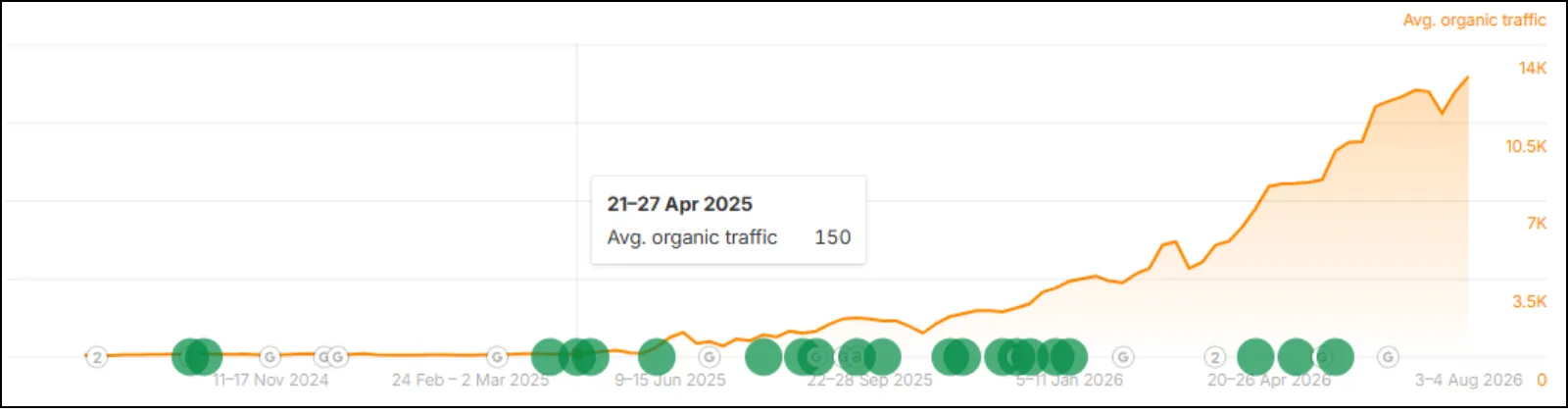
From 150 to 12,600 Monthly Organic Visitors
At the start of the project in April 2025, the eCommerce store was receiving around 150 organic visits per month. By August 2026, our SEO team had grown that to 12,600, an increase of 8,189%. Traffic climbed steadily through the second half of 2025 as the first content clusters started ranking, then accelerated sharply from January 2026 onward once the fabric and chemical safety guides had matured and the backlink profile had caught up.
From 32 to 3,236 Keywords in Google's Top 10
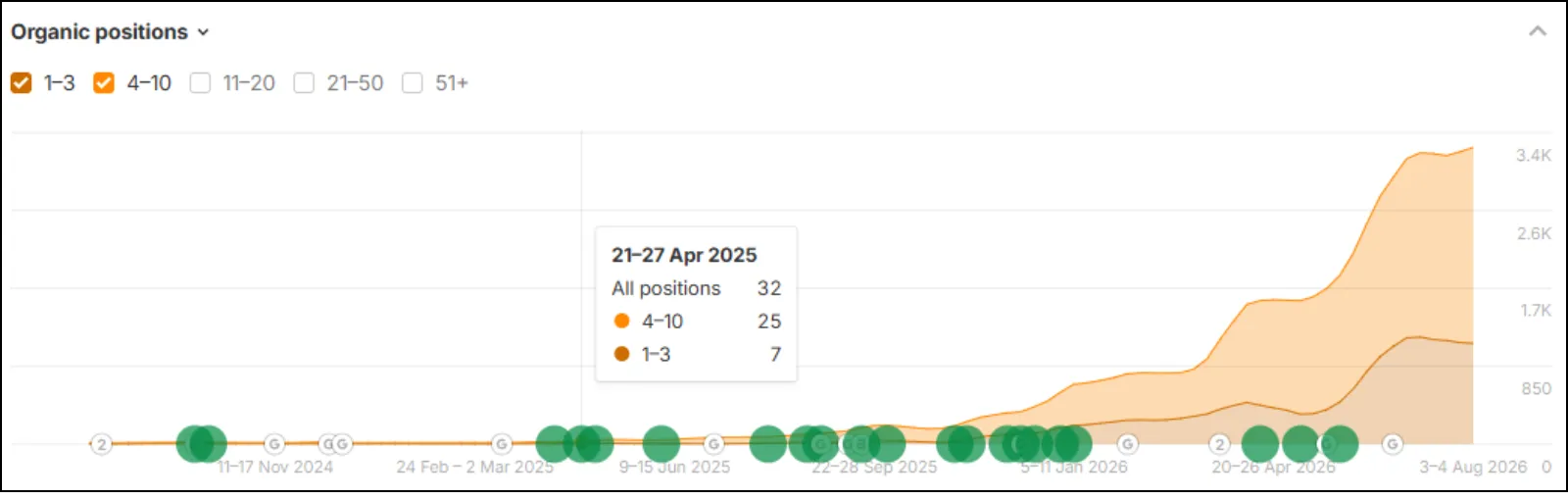
When we started, the website ranked for 32 keywords in Google's top 10, of which 7 held a top 3 position. The sustainable kidswear store now ranks for 3,236 keywords in the top 10, and 1,099 of those sit in the top 3. That is a 10,013% increase in top 10 rankings, with roughly a third of them in the positions where the majority of clicks happen.
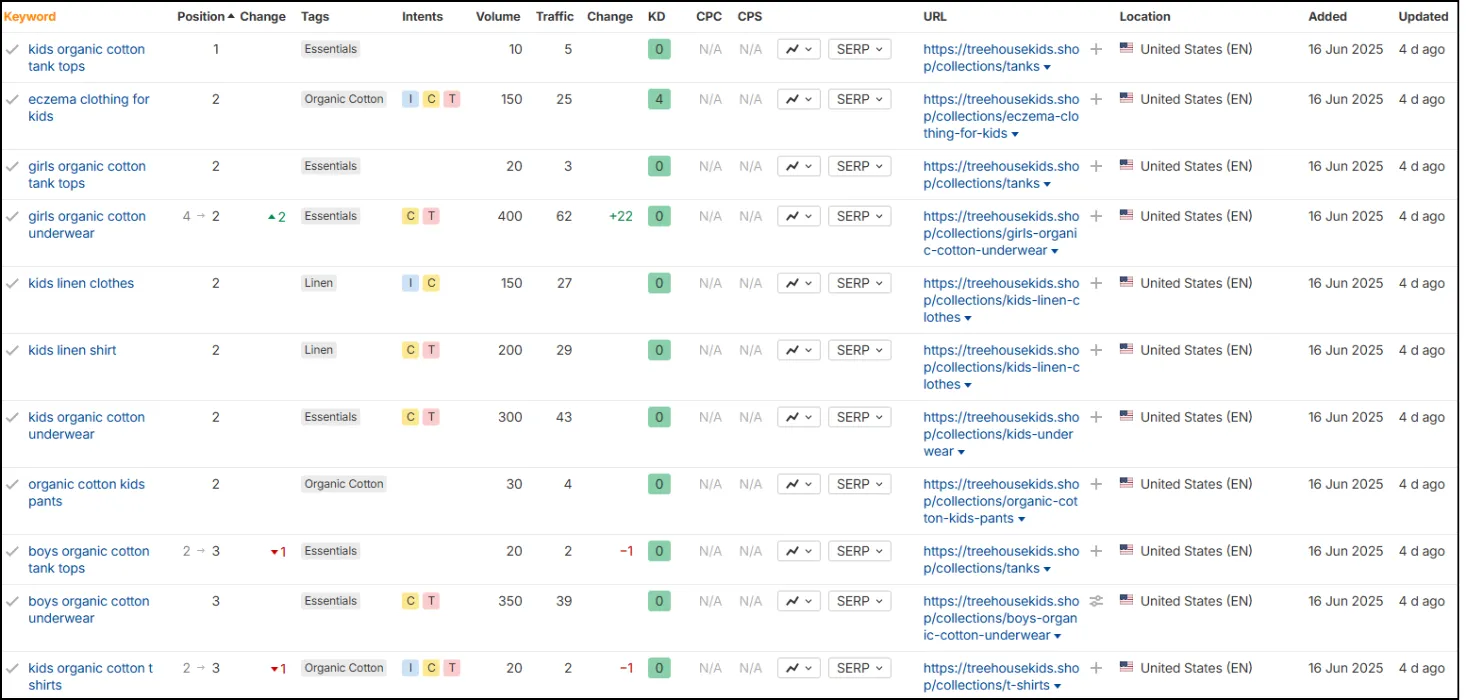
The collection pages we rewrote and built now hold the commercial terms that drive revenue. The website ranks 1st for “kids organic cotton tank tops” and 2nd for “eczema clothing for kids,” “gots certified baby clothes,” “cotton clothes for kids,” “linen clothes for kids,” “kids organic cotton underwear,” “kids linen clothes,” and “organic cotton kids pants.” These are buyer-intent searches, and the pages ranking for them are collections rather than blog posts, so the traffic lands one click from checkout.
High Visibility Achieved in Google AI Overviews
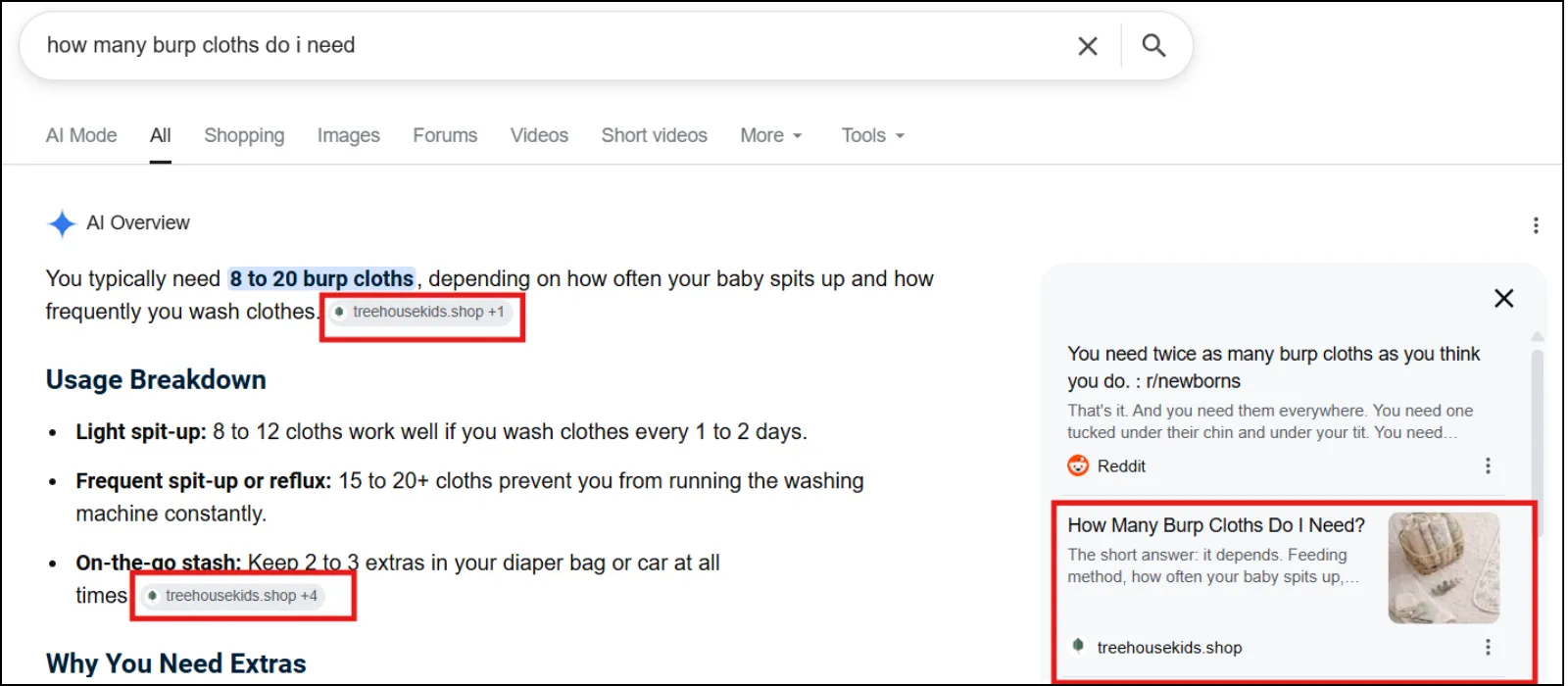
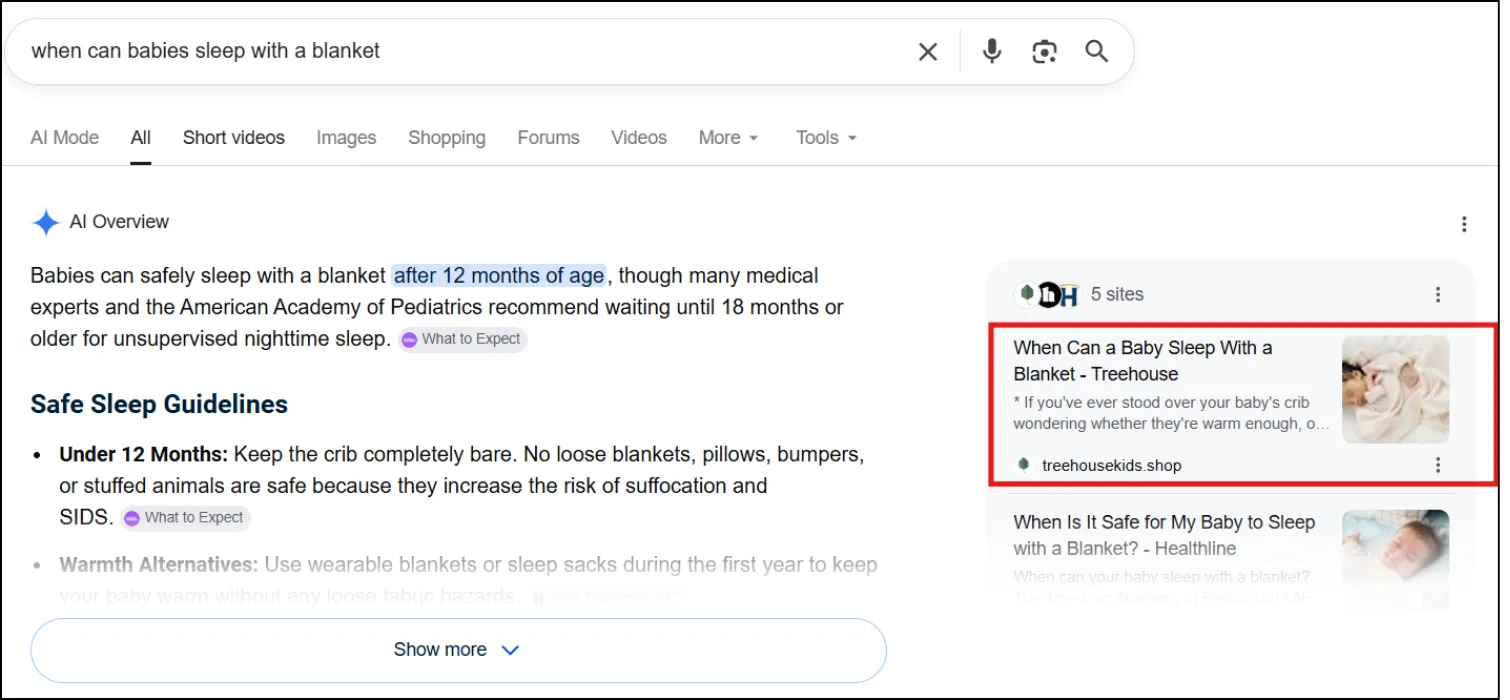
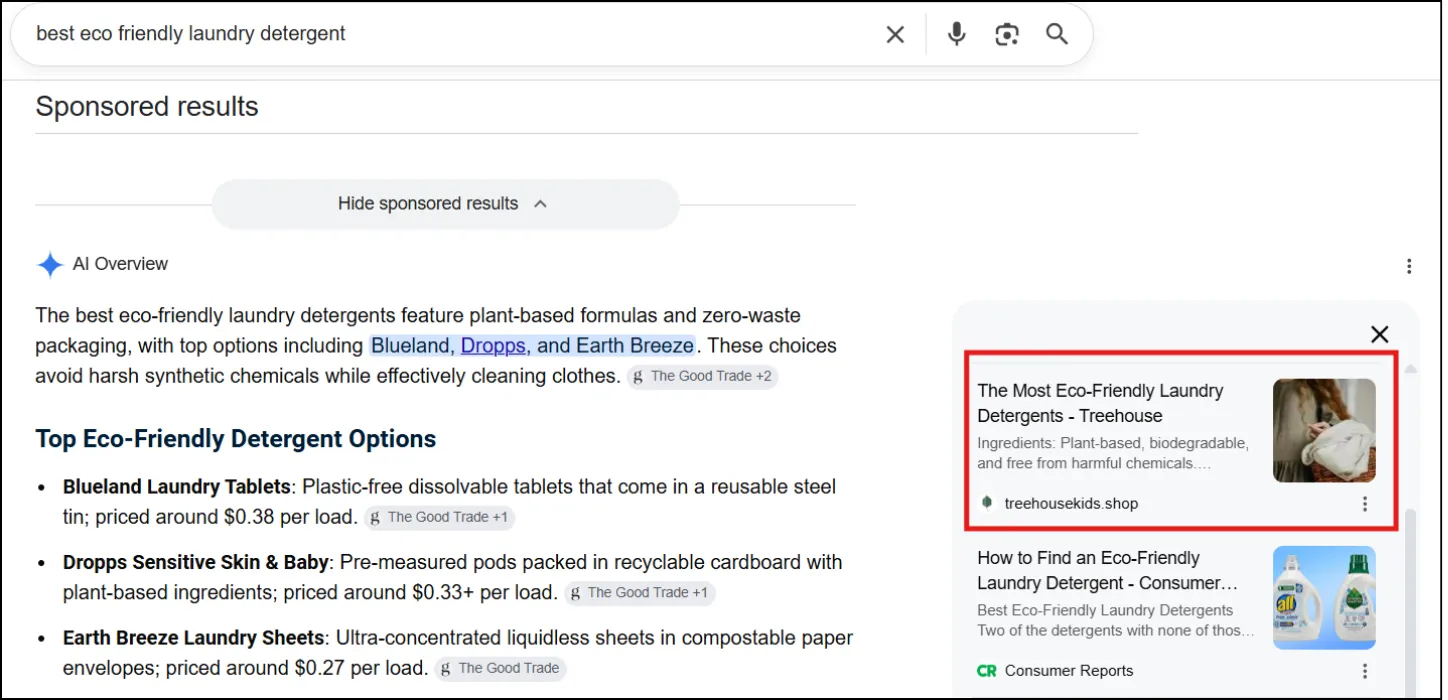
The articles of the sustainable kidwear eCommerce store are now cited across a wide range of Google AI Overviews, and the brand regularly appears as a source next to far larger publishers. Three examples show the pattern.
For “how many burp cloths do i need,” the AI Overview cites treehousekids.shop directly in its opening answer and again inside the usage breakdown, with the website’s article shown in the source panel alongside Reddit.
For “when can babies sleep with a blanket,” the store holds the first position in the source panel, above Healthline.
For “best eco-friendly laundry detergent,” a topic well outside the brand's own product range, our article leads the source panel ahead of Consumer Reports.
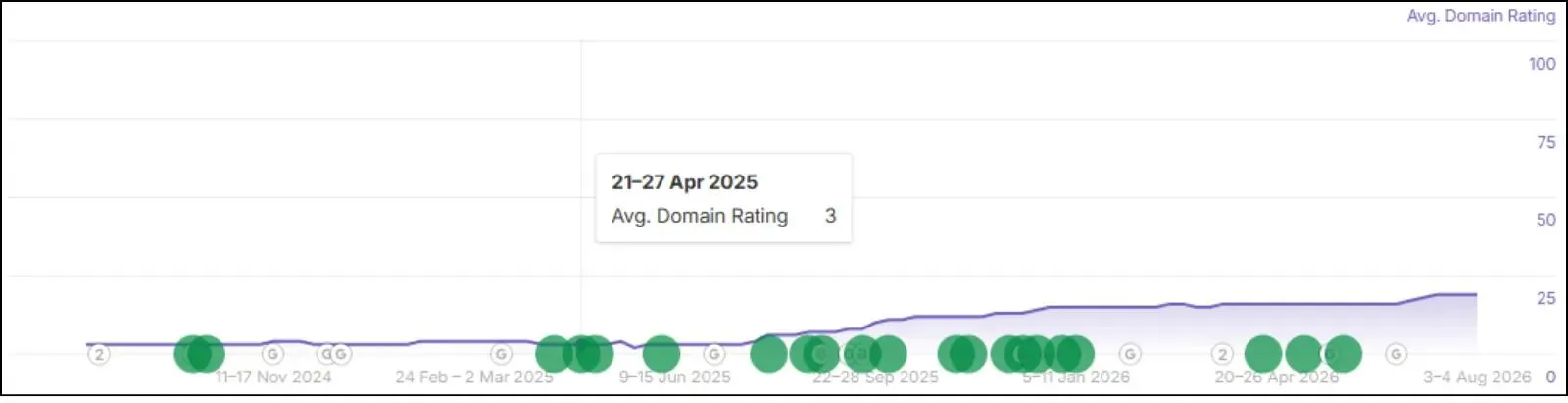
73 High-Quality Backlinks Acquired and Domain Rating Raised from 2.9 to 2019
Our link building team acquired 73 high-quality backlinks over the course of the project. The domain rating moved from 2.9 to 20, a 590% increase. For a young eCommerce domain competing against national retailers and parenting publishers, that authority gain is what let the content clusters convert rankings into traffic at scale.